Yesterday, Monday night, I had to get to the grocery store. After the long Canadian Thanksgiving weekend of eating Roast Turkey and homemade Turkey soup, my refrigerator was running low on supplies. Around 5pm I announced that I’d be going to the grocery store, but somehow didn’t manage to get there until 7pm. I’m telling you this because it was due to this delay in timing that I ended up speaking with this woman (who would like to remain anonymous). I walked into the health section of the store, where this woman was looking around. She asked if I worked there, since there wasn’t any staff in that section at the time. “Do you work here?” Boldly, and actually quite surprising to me I blurted out, “No, but I can help you”. She laughed. We both laughed. The store was closing so we talked very quickly and covered quite a bit of information. She offered to send me the comment that you will read below.
Thank you for stopping and speaking to me and giving me encouraging advice.For the last 10 years, I have been suffering from:
extremely high blood pressure that did not respond to any medication;
excessive sweating;
extra weight;
arthritis in my hips and knees;
swollen legs, and especially feet;
sores that did not heal;
several acid reflux;
varied digestive problems.
This all resulted in many visits to my family doctor, every possible specialist (including cardiologist, skin specialist, endocrinologist, gastroenterologist) as well as many very expensive and time consuming tests. Not one of the doctors seemed to help and my situation was getting worse and I was becoming quite desperate.
I am a very active female (both professionally and socially) in my late 60’s and I could not see going on like this for the rest of my life and did not see any solution.
Three weeks ago, I spent a weekend with friends and I mentioned to them how well I felt after it. What I did not realize is that they have no wheat in their diet. They lent me the book “Wheat Belly” and I decided to cut out the wheat. In just two weeks, most of the symptoms disappeared and I have lost almost 10 pounds without trying. In addition, I have no cravings for bread which I had before. I can also go without eating for many hours, which I could not do before.
My advice: give it a try for a few months and see what happens. I have started with the resolution to give up wheat for six months. I may never go back to it although may miss the taste of the fantastic breads I have been buying over the years.I am not a vegetarian and eat everything else. This has been much easier than I thought. Today I had a most fantastic gluten free chocolate cake in a mainstream restaurant. Everyone is becoming more aware of the problem and I am sure that as the time goes by, there will be more choices.So, thank you again for your help.
Wheat (Photo credit: Big Grey Mare ~ on vacation for 2 weeks)
The big, heavy question that came up last night was: “Why don’t the doctors tell us?” The answer is that most of them don’t even know themselves. Doctors are put up on a pedestal, by us. They are human and get tired and have to deal with a lot. Most often their own health suffers as a direct result of their demanding profession. They believe what they are taught or told from the powers that be (as do we) – it is a cycle. We should be grateful for those who are medically trained, who can help us in case of emergency. But sadly, our entire population has become ‘infected’ by a system of going-with-the-flow, more is better, all-you-can-eat type of mentality. With an attitude that THEY, those doctors and scientist will surely come up with something to fix our chronic state of disease to keep us comfortable as we age and decay.
We need to understand that we have to help ourselves. Banning certain foods, in my opinion, is not the answer. Rather, we need to educate ourselves and learn to make the right choices for our unique systems. And most likely, the direct result from choosing to NOT buy toxic food products is that they will lose their popularity and strong-hold on the market. If we don’t buy it they won’t produce it. No demand = no supply.
I’ve mentioned this article before: “Is Sugar Toxic?” by Gary Taubes and the video by Dr. Robert Lustig: “Sugar: The Bitter Truth“. The video is long (1.5 hour), but if you really want to be healthy and understand WHY what you are doing may not be working, then you need to watch this video (maybe many times) and read this article (maybe many times) until you really understand the information. My goal is to be able to explain this information to my children so that they are able to make their own decisions. Not just tell them that they can’t eat or drink certain things because those things are “bad for you”.
Slowly, I try to explain to my kids in basic terms what I have learned. This morning my daughter said: “Well, if you hadn’t given us those foods in the first place, we wouldn’t have gotten used to them.” My answer: “I didn’t know the information then, but now I do. We will educate ourselves and make these changes together.” Additionally, the important lesson for the kids to take away from this is that adults – even highly educated doctors – don’t know everything. We are all learning new things all the time. Each of us is an experiment of ONE. It is crushing when we discover that what we are doing is contributing to our disease. Belief is a powerful thing.
The natural state of the human body is to be healthy. You see how quickly this woman’s body responded to eliminating wheat/ gluten. She is not an isolated case. At a cellular level the human body tries so hard to maintain a natural homeostasis. But in order to do so, we have to participate and support an environment in which this incredible community of cells can do its work. Read Dr. Bruce Lipton’s book, Biology of Belief. He is an educator/cell biologist who explains this complex subject with ease.
Of course, I could go on forever but will end it with this one thought. In the day, do you hear yourself saying: “I can’t live without my…” or “I need my…” Consider that you actually can live without it. If you NEED it you are being controlled by it. It all takes practice.
I’ve embedded Dr. Lustig’s video for your convenience.
Everything takes practice. The Dalai Lama talks about practicing compassion. The key word is practice. It takes practice to be compassionate just like it takes practice to be able to run a 7-minute mile or to be punctual. Nothing just happens. And the list goes on. Life is about practicing, not always about perfecting. Learn new things and practice them forever. I don’t believe in mastery. There is always room to grow and more details to find, we are all eternal students. And so this is why I word my new learning in this way.
How to practice making a lot of different food at the same time for my family’s needs and health
And so on…
Want to Try?
Choose ONE thing you would like to improve or better yet something you have always wanted to do but held yourself back because of an excuse (valid or not!). Choose just one thing – maybe the first thing that pops to mind. Now make a commitment to practicing it consistently. You don’t have to sign anything or make a public declaration; it’s your word, your honour.
The “thing” you choose might have to be practiced every hour on the hour. It might be more often, like every time you open your mouth (?!), or once per week.
Every “thing” takes practice.
I’ve been practicing to be compassionate to everything. Even mosquitoes. I have made a conscious effort to assist any insect that happens into my house, back to the great outdoors (where I think they’d rather be anyways).
Here’s how I did it:
First, I enlisted my husband to catch the insect and gently put it outside.
When he wasn’t around I’d have to build up the courage to approach the insect on my own.
With practice and experience I became less fearful and more comfortable with the task.
I found myself spending many minutes in a dance of catch the insect, often letting more in house in the process.
Now, I know I have reached a state of compassion for all bugs. I look at them with fascination, curiosity and kindness. They have as much right to life as do I. As a result I have found one of my pleasures is to photograph insects. Who knew this could happen? All because I decided to practice compassion.
It takes practice to wake up a few minutes earlier every morning to practice my bed stretches. It takes practice to time my meals so that I am well fueled and adequately digested in order to practice my body maintenance exercises.
There is nothing special about me which enables me to run a 7-minute mile, to do a freestyle flip turn or take the time to relocate an insect to the great outdoors. All I’ve done is learned how to apply this magical element that is within each and every one of us, but has taken on an out-of-this-world status.
PRACTICE.
And it’s not that practice makes perfect. I’m not after perfect. “Perfect is a moving target.” Practice Makes. That’s it.
As my husband says: “It’s all about Discipline. And sure it’s Simple, but its only Easy if you Practice.
When we practice and focus our energy on something meaningful it seems like amazing things happen. But those amazing things are actually just run of the mill kind of things. Ask anyone who looks as though they are doing AMAZING things. They’ll just nod and shrug it off; to them its just a natural part of living – simply, who they are and what they do.
It takes me quite a bit of time to piece together a “day in the life” log. At this point, if you’ve read my other Food Log posts, you will have an idea of my patterns. So to make everything simpler – easier for you to read and easier for me to upload, the following is examples of JUST the food. As I’ve mentioned before in Rx Food that I have been experimenting as much as possible with eating my food in the right order, as per Dr. Mercola’s suggestion. Everything I eat is according to Blood Type O, non-secretor lists via the research done by Dr. Peter D’Adamo, Eat Right For Your Type. As well, I have been consciously cutting back on fruit. As far as Gary Taubes sees it, he doesn’t “think there’s much meaningful evidence on the benefits of fruits in the diet.” I used to eat fruit with abandon thinking I was making a healthier choice. As it turns out, our bodies don’t differentiate much on where the sugar comes from. (More on the sugar/fruit subject another day).
Dr. Mercola says:
“In addition to eating the right foods for your body, believe it or not, we discovered that it is not enough just to make the right food choices…It is equally important to eat your foods at each meal in the right order!
Many leading protein types should eat their meat first
Carb types should eat their vegetable first.
Mixed types should eat their meat and vegetable together.
When your food is consumed this way, digestive and nutritional efficiency will improve dramatically, shown by:
Improved meal satisfaction
No need for snacks between meals
No more food cravings.
Dr. Mercola has a basic Nutritional Typing Plan. Click here to view Dr. Mercola’s Nutritional Typing.
DAY 1
7 am My Breakfast: (in this order)
on an empty stomach: 20 mL Salus Artichoke Juice, followed by 6 oz. water
2 soft boiled eggs, sprinkled with sea salt
5 oz. Steamed Spinach (1/2 bag of Stahlbush Island Farms Frozen Spinach), with 1-2 TBSP. EVOO & fresh Lemon Juice
4 Organic walnut halves
4 Organic pitted Prunes (no preservatives)
small banana
12 oz. water
Day 1
8:30 am:
1 heaping TBSP. Salus Red Beet Crystals mixed with 8 oz. water (or 250 mL San Pellegrino)
Purple Thai Sticky Rice, Quinoa, Roasted Sweet Potatoes w/fresh ginger, cilantro, green onions, Olive Oil & lime juice
Steamed Kale
Salad:
Organic Romaine Lettuce, cherry tomatoes, fresh mint leaves and fresh basil leaves
Half red & orange peppers
Half organic Hass Avocado
Organic broccoli
EVOO & fresh squeezed lemon juice
12 oz. water
Afternoon snack, around 3:45 pm
1 Can Mackerel
4 Brown Rice cake thins
5 organic dried mission figs
5 mini organic carrots
I don’t usually have time to photograph dinners because it’s mostly too hectic.
Day 1
6 pm My Dinner:(in this order)
8 oz. BBQ Grain-fed NY strip loin, (seasoned with drop of Olive Oil, freshly ground pepper, garlic powder).
Steamed Kale
Roasted Sweet Potato w/ unsalted butter
Plain risotto w/ a pouring of saffron tea
Mix of wild & brown rice
raw carrots & broccoli
12 oz. water
Generally, when I know that I’m going to use the oven or BBQ, I will plan ahead and grocery shop accordingly. For example, if we are having Salmon for dinner, I will buy enough to have leftovers for the following day. Assuming we will eat a total of 1.5 pounds of Salmon at dinner I will buy 2 pounds to ensure leftovers for the following days lunch or snack.
I will also bake two other types of fish, seasoned differently, with the purpose of having those ready for lunch or dinner the following day as well.
When I BBQ, I tend to prepare my NY strip loin, marinated turkey cutlets and sweet potatoes at the same time – with the intention of having leftovers.
When I prepare rice or pasta, I will make enough and a few varieties at a time to ensure leftovers.
I try to always have washed and cut up carrots & broccoli as well as a steamed green vegetable like, Kale, Collard Greens, Swiss Chard or Green Beans ready to eat in the fridge.
Preparing my family’s food supply in this way actually makes for less work and much less stress on my part. It definitely has taken a lot of daily practice for me to figure it all out, but as a result, I know my way around my kitchen better than I ever!
As per request from a fellow blood type O, non-secretor I will post a few daily Food Logs as well as some sample meals with photographs over the next while. Because I choose to eat well all the time, I have to be prepared for hunger! As a result, I have to ensure that my refrigerator is stocked with ready to eat wholesome foods. I have to plan ahead and spend a certain amount of time preparing. Convenience foods aren’t in the cards anymore.
Aug. 27, 2012
6:30am Wake-up but not moving until 7am, (summer holidays).
7:00am Bed Stretches
7:10 am Homeopathic Remedies + Iodine, Zinc & Vitamin D supplements. I do a few standing side bend stretches while holding two of the homeopathic remedies under my tongue, since I have to hold each for 15 seconds. I’ve learned that I can accomplish a lot in 15 seconds.
From my perspective supplements should be used short term.They supplement what is not working for us naturally.
My goal is to figure out why my levels are low and to use the supplements as a support while I figure out how to get my levels up to MY normal range of healthy functioning. Eating the right way should support our systems properly, which should eliminate the need for supplements (in an ideal world). For example, I was taking twice the amount of Iron Citrate, and Magnesium Glycinate almost two years ago. About six months ago, I was able to lower my daily dose to half that amount.
Then I do my 4 minute morning routine which includes: rolling out with Travel Roller ball & roller, wall stretches, 2 modified Sun Salutation plus the actual 4 minute morning which actually takes me 5 minutes to do Week 3 – DAY 7. (I have modified this for myself since originally uploading it and will endeavour to make an update of it soon.)
This mornings routine was broken up with sorting laundry and doing Dot’s braids, puttering around etc. Adapt to change and carry on.
8:30 am 6oz. glass water
Making all breakfasts simultaneously…
8:50 am My Breakfast:
2 soft boiled eggs
5g (approx. 2 cups) steamed Spinach drizzled with EVOO & fresh lemon juice
6 Walnut halves
4 prunes
Small banana
12oz. glass water (Iron Citrate & Magnesium supplement)
8pm – 9pm Help Dot create her first stop-motion animation film!! It took a lot longer than I thought it would. That hour was spent just collecting footage.
Three out of four of us love this recipe. ‘Dot’ is not so into it, she has only just turned eight years old and still gets a little turned off by bits of green herbs in her food.
This is another tried-and-true recipe from Jamie Oliver ’s book: The Naked Chef. You can find the recipe on page 95.
Cover of The Naked Chef
We try not to eat too much tuna on a regular basis because of its potential for high levels of mercury. But when we do have it we either order it at our favorite Japanese Restaurant where we know the chef and respect his standards for quality control or I buy it fresh from Longliner Seafoods Ltd. at Granville Market.
I don’t always follow the recipe exactly. If I don’t have a dried red chili, I use a teaspoon or so of dried red chili flakes. And in place of coriander seeds, I will use a generous teaspoon of ground coriander. And I usually add more garlic. Those are my only deviations.
Ingredients (My Version):
1 tsp. dried red chili flakes
1 generous teaspoon ground coriander
1-2 garlic cloves, crushed
1 good handful of fresh basil, finely chopped
1 good handful of cilantro, finely chopped
juice from 1 lemon
sea salt and freshly ground black pepper
3-4 tuna steaks
Directions:
Mix together in a small bowl: red chili flakes, ground coriander, crushed garlic, chopped basil & cilantro and lemon juice. Add sea salt & freshly ground pepper if desired.
Rinse Tuna Steaks with cold running water, pat dry and place on a dish big enough to coat each tuna steak with the herb mixture.
Preheat a large frying pan. Jamie says to get the pan “very, very hot” then pour some oil on a paper towel and quickly rub the frying surface of the pan. Do this quickly and only once the tuna steaks are ready to go immediately into the pan, otherwise, the oil will start to burn.
Actually, rather than tossing the steaks in the pan, be precise with placement because they will stick onto the place you put them. Once in the pan you will not want to move them around. After 45 – 60 seconds of searing, it will be easy to turn them over for another 45 – 60 seconds.
Letting each steak sear for 45 – 60 seconds on each side.
We (the adults) prefer our Tuna Steaks cooked a little more than traditional searing. Our son, however, prefers it closer to sashimi – I try to strike a balance. We leave our raw fish eating for our Japanese Restaurant outings.
You will notice in the finished product at top, that the centre of the fish is more pink than red. I will sear them for 90 seconds on each side, then cut through the middle and see how it looks. Remember to factor in that even once the fish is removed from the pan it will continue to cook a bit longer.
This is the kind of dish that you want to cook and serve immediately. So having the rest of the meal prepared and on the table makes for a winning combination.
Sometimes when I know that I want leftovers, I will intentionally sear the Tuna Steaks for less time so that when I reheat them the following day they will be just right and not be cooked through like canned tuna. They are also great served cold on a salad the following day; I create my version of a Salad Nicoise.
Serve with an extra wedge of lemon. I like to serve with a green salad, steamed kale, roast sweet potatoes and brown rice. The possibilities are endless.
Enjoy!
Fresh red chile de árbol chili peppers (Photo credit: Wikipedia)
FYI: Eat Right 4 Your Type
This recipe averages out as Neutral for all types. However, A and AB blood types, both secretor and non-secretors should omit the red chili peppers. Tuna is listed as Beneficial only for AB blood types, for both secretor and non-secretor.
Below is a Blood Type Table for Seared Tuna Ingredients:
Blood Type
Tuna
Cilantro
Basil
Red Chili Pepper
Coriander
Lemon Juice
O secretor
Neutral
Neutral
Neutral
Neutral
Neutral
Neutral
O non-secretor
Neutral
Neutral
Beneficial
Neutral
Neutral
Neutral
A secretor
Neutral
Neutral
Neutral
Avoid
Neutral
Beneficial
A non- secretor
Neutral
Beneficial
Neutral
Avoid
Beneficial
Beneficial
B secretor
Neutral
Neutral
Neutral
Neutral
Neutral
Neutral
B non- secretor
Neutral
Neutral
Neutral
Neutral
Neutral
Neutral
AB secretor
Beneficial
Neutral
Neutral
Avoid
Neutral
Beneficial
AB non- secretor
Beneficial
Neutral
Neutral
Avoid
Neutral
Beneficial
This table is accurate as of the date of publishing this post. Check with the source for an up-to-date listing at Dr. D’Adamo Type Base 4. Click on any food item and it will show you an incredible page summarizing everything you might need to know about that food. Wow! Really, check it out.
On January 10, 2012, I read Carly Weeks’ article featured in the Globe and Mail, “Harper must demand action on sodium levels, health groups urge“. To view the article in its entirety click here. I got so heated about this topic (can you guess why?) that I started to compose this post right then and there. I had other pressing chores that morning but could not let this go. In the end I didn’t have time to finish until now, six months later. But serendipity strikes again, for today (July 11, 2012) I read about the “California class-action lawsuit that slammed the makers of Nutella for ads suggesting the spread was a healthy food [it] was settled this week in favour of consumers.” (Tralee Pearce, Globe and Mail). To view the article recounting this ridiculous ruling click here.
Regarding sodium levels: Yes, I agree it would be good to bring sodium levels down, but more importantly choose to stop buying ready-made products; problem solved. Regarding Nutella: No, I disagree with the settlement. However, I think that this is a great opportunity to talk about taking personal responsibility. We, as a collective don’t really need to wait for our governments to take responsibility for ourselves – or do we? Can we not choose to prepare more healthy foods from home as opposed to consuming and relying so much on ready-made, pre-packaged food? Waiting on the ‘other guy’ to solve our problems or make us healthy hasn’t done much for us thus far. In these two cases, generally speaking, the problem isn’t with our governments or manufacturers, it is with the pre-packaged foods, which are loaded with sodium and unhealthy ingredients and making the choice to buy them in the first place. We need to take personal responsibility and read the labels. Better yet, cut back, if not stop altogether, buying and eating foods that come with labels. Eat less pre-packaged food and work on choosing whole natural foods that don’t come with ingredient lists. But, if you must, then in the case of sodium in particular, look for labels that have less than 5 mg of sodium PER SERVING (and good luck finding any, by the way – which takes us back to the first article). If nothing else we can use these points as an opportunity to start evaluating this one aspect of our health.
“Ay, there’s the rub.”
The conundrum is that if we don’t have the desire to self-educate, to ask questions and search for meaning then we can easily accept what we are told to be absolute. I squirm inside whenever I hear someone exclaim with a strong measure of conviction: “THEY say (or I’ve read) that (enter product here) is good for you.” How do THEY know? Who are THEY? And why do we believe THEM without experimenting for ourselves?
As we all know, there are countless products being peddled that purport to transform our lives. Beautiful images of apparently perfect human specimens lure us to buy everything from skin and body products to nutritional supplements. And all the convincing research, don’t forget the convincing research studies…
We are only as strong as our weakest link.
What if, you don’t know that you don’t know? If we are raised by seemingly well intentioned parents who don’t know much about a healthy lifestyle, and surround ourselves with like-minded individuals, and believe everything advertisers promise…”Ay, there’s the rub.”[1]
“I’m sick of parents blaming everyone from McDonald’s and their Happy Meal toys to cereal companies and their jovial cartoon characters for trying to make their kids fat and unhealthy, when it’s our job first and foremost to determine what foods they eat and don’t. It’s a little thing called personal responsibility,” she writes. “So congratulations on the [Nutella] lawsuit, but I find it ridiculous, and it’s frankly insulting to consumers and mothers who DO read labels.”
By the way, my daughter eats a version of Nutella (Nocciolata) FROM TIME TO TIME – NOT EVERYDAY!
With respect to Nutella and ready-made products? Cut back on consuming them, eventually, eliminating them entirely. Many may panic at the idea of cutting back on the convenience of ready-made processed foods, but I promise, you will survive.
In fact you will likely start to thrive.
Over the last year and a half, I have been working on cutting out all processed foods – I open few containers and packages these days, which is having a positive impact on my carbon footprint. Mostly, I make everything from fresh whole natural foods. Sure, it takes time and practice, but just about anything is possible with enough practice. What could be more important than nourishing our health and the health of those we love?
“One always has time enough, if one will apply it well.”
Look at what the human species has accomplished, it is mind-boggling. In the same breath I can think of many inventions that are used everyday that are unfinished and by that I mean they have fallen short, causing more problems. Pre-packaged food is one of the items on my list. So take your pick: Convenience or your health. THEY want you to believe that you can have it both ways.
Hey, you gotta live!
(I say this with healthy dose of sarcasm in case it isn’t obvious. A kind of paradoxical-oxymoron.)
My strategy is to prepare enough food to ensure leftovers; this way, I’m never scrambling at the last minute and tempted to grab whatever is convenient. I’ve become a short order cook for my family, and I have learned to love it. Meal times have become more of an opportunity to educate and reawaken our natural instincts and intuition about what foods make us feel well, feel nourished and fueled.
Besides, imagine the environmental effect we are having on our planet by the amount of processed products we purchase each day! Have you seen this film?
Don’t misunderstand; I’m not saying that my kids always eat what I want them to eat. In fact they often want to eat the junk that their friends eat. As much as it makes me cringe, I know that it only makes up about 10% of their diet and one hundred percent of the time they admit to how lousy they feel from eating it. The lesson for me is that I have to let them experience these things for themselves, within reason. We talk about ingredients and how certain ingredients affect the body etc. It’s not easy training children to become responsible for themselves. They want to make their own decisions but our job as parents is to protect them from themselves. It’s not so different from having dogs. Our dogs like to eat everything they smell, much to their own detriment; they are indiscriminate with what they will ingest – because they don’t know that they don’t know!
The most important message I can leave you with is that children cannot eat whatever they want all the time. Their bodies will not “figure it out” as they grow-up. Many adults have said to me over the years that, they ate whatever they wanted as a kid and they turned out ok. It’s not about the size of our body or the amount of body fat we carry, it’s about the damage that we cannot see, what we are doing to our internal body, our organs and cells.
Lets review:
What is Sodium?
Sodium is an essential nutrient.
Sodium is one of the primary Electrolytes in the body.
All four cationic Electrolytes (Sodium, Potassium, Calcium and Magnesium) are found in unrefined salt.
BUT too much Sodium is bad for you.
Sodium is a mineral.
It is a chemical element, Sodium (Na) also known as Sodium Chloride (NaCl).
Sodium is naturally occurring in most food sources.
What is Table Salt?
Table salt is refined salt.
Table Salt is Sodium with additives:
Table Salt contains 97% – 99% Sodium Chloride.
3% -1% is additives.
The additives vary from country to country.
Some countries that do not have fluoridated water add Sodium Fluoride to their Table Salt.
Some countries add Iron and Potassium Iodide Salts (Iodine) to their Table Salt
Some countries add Folic Acid to their Table Salt.
Some countries add Inverted Sugar Syrup to their Table Salt.
Most Table Salt contains anti-caking ingredients: Calcium Silicate, Sodium Thiosulphate, Sodium Ferrocyanide, Magnesium Carbonate, Tricalcium Phosphate etc.
What is Sea Salt?
Sea Salt has the same Sodium content as Table Salt.
Sea Salt is obtained by the evaporation of seawater.
What is Iodized Salt?
Iodized Salt has the trace mineral Potassium Iodide added.
Iodized Salt will be clearly labeled: contains dietary iodine.
Because access to natural sources of iodine, such as saltwater fish, sea vegetables or plants grown in iodine-rich soil are scarce in some parts of the world, Iodine is a welcome addition for health reasons.
The Thyroid gland needs a certain amount of dietary iodine to function properly.
CAUTION – Sodium in disguise:
Soy sauce, fish sauce & oyster sauce.
One Tablespoon of Soy Sauce = ~900mg of Sodium
One Tablespoon of Bragg’s Soy Sauce (non GMO) = ~660 mg of Sodium
One Tablespoon of Fish Sauce = ~1190 mg of Sodium
One Tablespoon of Oyster Sauce = ~492 mg of Sodium
One teaspoon or 6 grams of salt contains about 2,400 mg of Sodium.
Which exceeds the Tolerable Upper Intake Level! For optimum health we should
NOT exceed 1,500 mg per day.
How much Sodium does the average Canadian consume each day? 3400 mg.
What happens when we consume too much Sodium? Some associated diseases or conditions include: Stroke, Cardiovascular Disease, High Blood Pressure, Renal (Kidney) Disease, Stomach Cancer…
How much is an ideal amount of Sodium per day? From the age of one year and up the range is from 1000 mg to 1500 mg per day. (Tolerable Upper Intake Level – UL – and not to exceed is 2,300 mg).
Now how confusing is the following statement?
“When people are cutting back on salt in their diets, what they really mean is that they are concerned with their sodium intake, because it is the sodium that kills, and not the salt. It should be mentioned, that even when people avoid consuming salt, they might still get a lot of sodium from other sources. So in effect, staying away from salt is NOT the only solution.”
You have to read it carefully to understand that it is not just the Table Salt “shaker” or the Sea Salt “Mill” that we have to cut back on, BUT to be very aware of the naturally occurring Sodium in the foods we are eating IN ADDITION to the ADDED Sodium, which is found in processed, prepared, and pre-packaged foods.
Help Yourself:
Begin weaning yourself off processed foods.
Start by noticing what your daily food habits are.
How many products do you eat each day that come from a package?
Plan ahead and pick ONE day to experiment with limiting your consumption of anything that comes processed.
When you are ready, try keeping a food diary one day a week.
And add up the amount of sodium from the foods you ate in that day.
To date, I’ve been experimenting with food as medicine for a solid year and a half.
In a recently published post, titled: My Hernia, I described my experience with an umbilical hernia, and by the end of the article I commented on the fact that some exercises can be useless. Which triggered another thought…how certain foods can actually be useless too.
There are a lot of fancy exercises that are in vogue these days, that fall into the useless category causing more harm than good. Now, this is assuming we know better but keep on repeating them, regardless. However, because it’s unlikely that doing the occasional useless exercise likely won’t cause much lasting damage, it begs the question, then WHY would we do them in the first place? What is our motivation behind doing things that are useless? Our best bet is to stick with the basics, but also to work with an expert who can identify which basic exercises will actually be beneficial for our specific needs. (Collaborating with an RMT trained in Rolfing [Structural Integration] or KMI / Myofascial Release is my first choice). Sure, we can go ahead and do exercises, which are not appropriate for us and survive…(clearly, there are worse things we can do!). But, from my perspective, if we’re going to bother in the first place, doesn’t it make sense to at least try to do it right? Getting to the point of doing it right can take a lot of trial and error and a lot of research; if we’re too busy to learn and grow, then what are we here for? I have come to have this same opinion about food as a result of exploring which foods actually support my health. We can go ahead and eat anything for energy, but if we’re going to bother, doesn’t it make sense to do the research and fuel ourselves accordingly to actually enhance our health?
…Prescription Food, as I’ve come to think of it.
Why not?
I met Sandrine at my daughter’s school about three years ago. Our daughters have been in the same class over these few years and so naturally, we have had many opportunities to chat. And as parents often do, we talk about our daughters; their talents, milestones and of course the challenges: the sleepless nights, the food sensitivities/ allergies, which doctors 😉 or finding THE magical balm to soothe irritated skin, etc. – You get the idea.
Sandrine went the distance like no other to help both of her daughter’s with their skin issues. She had eliminated certain foods from her girls’ diet in the hopes that that would help. She would go so far as delivering fresh homemade meals to her girls everyday at lunch so they could stay true to their program. This kind of effort puts tremendous strain on a parent; anyone raising a child with allergies or food sensitivity knows only too well what I’m talking about.
Six months into my experiment with ER4YT, I happened to be chatting with Sandrine at our girls’ first chess tournament. Since Sandrine and I share a similar interest in following current news regarding health, our conversations often revolved around comparing notes on such topics. I told her about ER4YT and my suspicions about gluten causing my joint inflammation. She considered looking into it as a possibility for her daughters. Sandrine is a researcher…she will leave no stone unturned. Months later, once back to school in September, I sidled up to her to get an update on the skin issues…because when I greeted her daughter, it was quite evident the skin issues were no more.
“Soon after my child was born, I knew that it was food which contributed to her rashes and other issues. The skin tests did not reveal food sensitivities, but food allergy. However, avoiding the foods my child was allergic to did not bring relief, in fact, it got progressively worse over the years. When I asked for their advice, Allergists and Dermatologists talked about elimination diet and its challenges. Recently, after almost nine years and two kids later, I discovered ALCAT testing. ALCAT and our naturopath transformed my children’s life and naturally mine. With ALCAT, we are confident in what they can and cannot eat. The recommended rotation diet along with the ALCAT test meant no more rashes or eczema, bleeding wounds from scratching, thick dandruff on the scalp, sleepless nights due to scratching, respiratory congestions, fatigue and failure to thrive. Today, my kids are not only doing well, but thriving, all without the need for medicated ointments and medications.” -Sandrine
This is an incredible story, and yet, elements of it are universal.
I know most of you reading this don’t know me and at this point are genuinely wondering if I am advertising for ALCAT or ER4YT. With all sincerity, I promise you that this is an information sharing website only. I do not have any affiliate codes associated with any of the links found on my site and am not receiving and discounts or support from the practitioners with whom I consult.
Any pop-up advertising you may see on my site from time to time is generated by WordPress, my host, who benefits from it in order to keep the operating costs down.
Sandrine did her research and took the blood type philosophy to the next level by actually having both her daughters and husband’s blood tested by ALCAT. Seeing her success with the program I am considering trying ALCAT testing for my family too. Right now, however, we are going to go the distance with ER4YT because we are still in the infancy with our exploration. My husband and I have done the Secretor Test, which helps to fine tune our beneficial food lists (I am blood type O+, Non-Secretor, my husband is AB-, Secretor). My kids will be taking the Secretor test next week – we are all curious for the results. My kids are becoming more and more interested in taking care of their health, now, and beginning to understand the significance of NOW, and the impact it will have on their adult health. Many people falsely believe that children can eat and drink whatever they want. They believe that kids will figure it out for themselves like so many of us did. I say, look around…there is an entire population plagued with an inability to figure it out for themselves. Our health will not fix itself. Raising kids on candy and sugar and processed foods is damaging, period. There is absolutely nothing beneficial or nutritious found in those products. But what if you’re like Sandrine or myself, who make every attempt to nurture healthy habits by introducing nothing but whole foods to our babies, to then being completely mystified that those supposedly healthy, super foods are not tolerated.
Yes, we can eat anything. We can drink anything. Most of us know of, or may even be related to people who do not espouse a healthy lifestyle in the least, but are still living- against all odds. You know, like James’ uncle who each day smoked half a pack of cigarettes, drank like a fish and never exercised, but lived to be 102. Mind you living a long time and living well for a long time is a horse of another colour. I often wonder what the longevity might have been for people like James’ uncle had they taken care of themselves?
I know a man in his mid-seventies who has been Diabetic (type 2) for thirty years. For many years when he had kept his Diabetes ‘under control’, his weight had stabilized at 200 pounds, which seemed like an acceptable weight for a man at a height of six-feet. He is currently sixty pounds over that weight. It seems like his weekly schedule is busy with regular check-ups with his doctors or advisers. When I ask him how he’s doing, he tells me that his doctors tell him that he’s doing OK. This frustrates me, so I ask him gently, “How can you be OK, when you are 1) Diabetic and 2) sixty pounds overweight? You are NOT OK. This is unacceptable.” He continues to do the same thing he has always done, which rewards him with the same results he’s always gotten. No change to his health; just a slow decline. He tells me, “Well, we’ve all got to go sometime.” This is true, none of us is getting out of this life alive.
But there is a huge difference between accepting our fate and having the belief that there is no fate but what we make.
“Since the dawning of the Age of Genetics, we have been programmed to accept that we are subservient to the power of our genes. The world is filled with people who live in constant fear that, on some unsuspecting day, their genes are going to turn on them. Consider the masses of people who think they are ticking time bombs; they wait for cancer to explode in their lives as it exploded in the life of their mother or brother or sister or aunt or uncle. Millions of others attribute their failing health not to a combination of mental, physical, emotional, and spiritual causes but simply to the inadequacies of their body’s biochemical mechanics. Are your kids unruly? Increasingly the first choice is to medicate these children to correct their “chemical imbalances” rather than fully grappling with what is going on in their bodies, minds, and spirits.
Of course there is no doubt that some diseases, like Huntington’s chorea, beta thalassemia, and cystic fibrosis, can be blamed entirely on one faulty gene. But single-gene disorders affect less than two percent of the population; the vast majority of people come into this world with genes that should enable them to live a happy and healthy life. The diseases that are today’s scourges – diabetes, heart disease, and cancer – short circuit a happy and healthy life.
These diseases, however, are NOT the result of a single gene, but of complex interactions among multiple genes and environmental factors. “
I understand that our doctors only have about 5 – 30 minutes with each patient (the upper number if you’re lucky!) and it is equally frustrating for health care practitioners, because as much as they want to eradicate disease, their hands are tied. Patients MUST help themselves and be more than a willing participant who accepts pharmaceuticals as their cure.
There are so many websites promoting miraculous cures, from natural supplements, water purification systems to products or equipment. It’s easy for any consumer to be charmed by all the claims often accompanied by glossy photographs of eye-catching perfection. All these advertisements remind me of the traveling-snake-oil-salesmen from the 19th century – Are we still being duped? Clearly, the only way to know for sure is to experiment for ourselves (with caution!).
Having said this, most of us are skeptics and require a lot to convince us to buy a product. But isn’t it interesting that when we finally do decide to jump in, and put our whole belief into something, we become a self appointed spokesperson for said product. As if, because it might work wonders for us, we think everyone else should try it too.
Listen, I don’t know exactly what works for me. I’m still figuring things out. And it seems to always be that once I get a handle on what seems to work my body goes ahead and ages, bringing on new changes and challenges. We are in a constant state of change. I believe we have to stay alert to these changes and adapt to them.
KEEP
CALM
AND
ADAPT
to CHANGE
In writing this post it is my hope to encourage others to consider that: because none of us know anything for certain, that we have to try and keep trying and not sit back accepting our ‘fate’.
For those interested in exploring Prescription Food for Our Individual Health, I have imbedded the links to the sites that I have personally explored. I have done Dr. Mercola’s Nutritional Typing questionnaire, which pegged me as a Protein Type (which is very similar to ER4YT, just without the blood typing). One thing that I took away from Dr. Mercola’s site that I have been experimenting with is: the order in which I eat my beneficial food.
Dr. Mercola says:
“In addition to eating the right foods for your body, believe it or not, we discovered that it is not enough just to make the right food choices…It is equally important to eat your foods at each meal in the right order!
Many leading protein types should eat their meat first.
Carb types should eat their vegetable first.
Mixed types should eat their meat and vegetable together.
When your food is consumed this way, digestive and nutritional efficiency will improve dramatically, shown by:
Improved meal satisfaction.
No need for snacks between meals.
No more food cravings.
Dr. Mercola has a basic Nutritional Typing Plan. Click here to view Dr. Mercola’s Nutritional Typing.
In addition, this 5 minute video presented by HU Medicare Local, Australia talks about Understanding Pain. There is a lot we can do for our own self-care. Whether we live a long or short life, I think that we can all agree that the best choice would be to live out our days at a healthy weight, without pain or debilitating disease.
This goes out for anyone struggling with mental, physical, emotional or spiritual challenges…I care about your well-being and hope that the information in this post will be useful for your exploration. Just try and keeping trying.
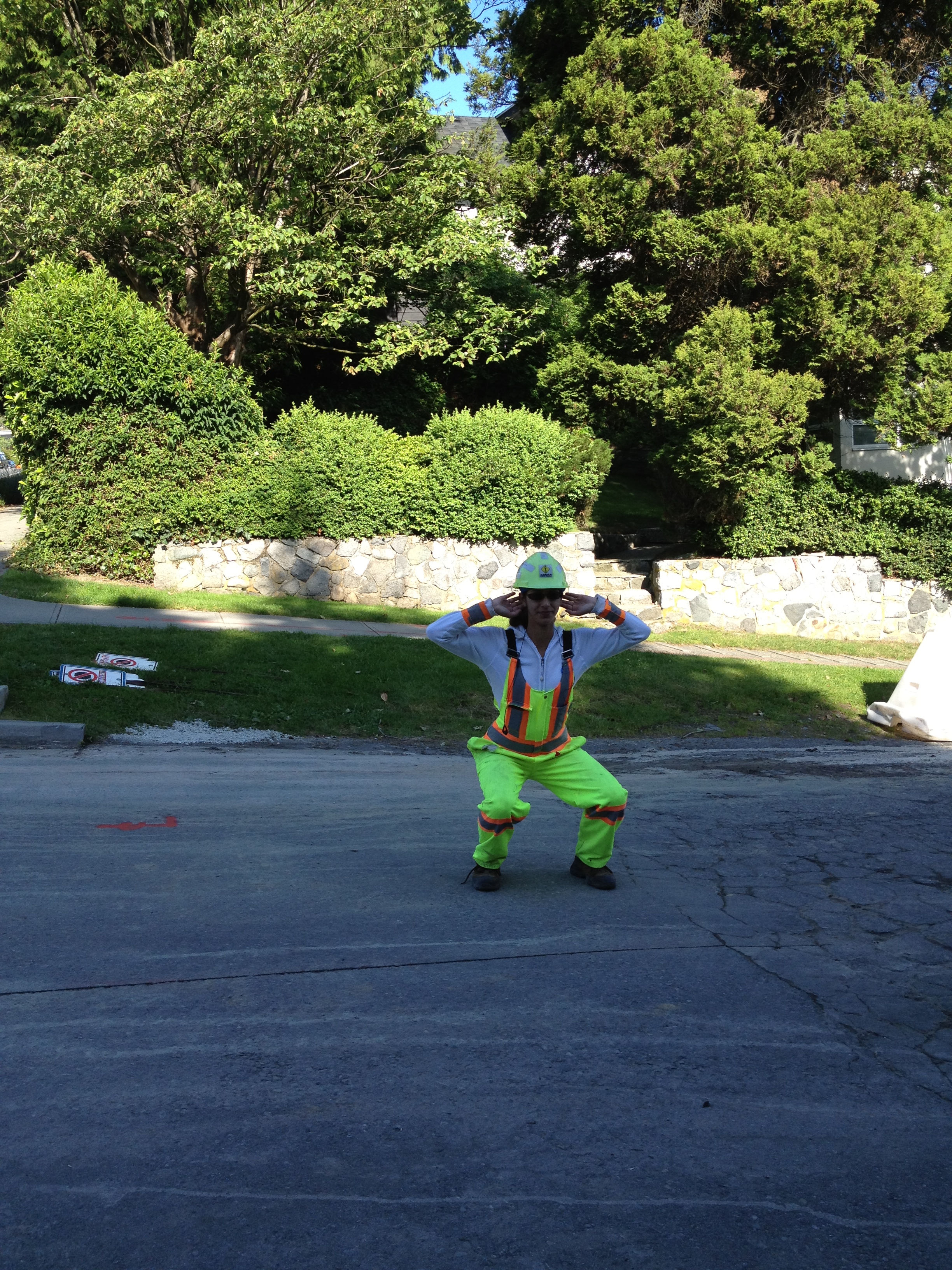
Driving home from my 10 minute morning hill sprint with dog Ruby and my 9 year old son, I happened to see Amanda doing some Prisoner Squats at the side of the road.
Amanda is a Flag Girl with the city’s sewers crew. I parked my car and high tailed it over to chat with her about what she was doing. With my son and dog in tow, I told her what I had witnessed. She explained that she had been in a motor-vehicle accident on March 27, 2012 and since has been in a lot of pain. She had gone through all the required active rehabilitation for the soft tissue damage. However, since the physical treatments that were covered by insurance had come to an end she had to become self-sufficient and consistent with doing the prescribed exercises throughout the day on her own. She quickly showed me the list of exercises on her phone.
Yay, Amanda!
Because her job requires for a lot of standing she finds that the immobility is what contributes to her pain. As a result she does whichever exercises she can while on the job.
I can’t tell you how happy I was to see this. On one other occasion I noticed a Flag girl doing some lunges and now wonder if it was Amanda then also!?
I’ve often wanted to contact the city and offer to give a workshop on how workers can help themselves throughout such long days of mostly stationary work – because standing around (though at least there is movement), can be equally difficult on the body as sitting at a work-station all day. In addition, I think that long hours, like what Amanda does can often leave workers fatigued by days end and the last thing they want to or feel motivated to do is think about doing a ‘workout’. So what if people in this situation could be shown (and convinced) that some, focused exercises done with precision, specific to their needs could do a world of good!
This is why I love the 4 Minute Morning concept as well as Stretch B4 Bed idea too. Each session doesn’t have to be an event, but rather a few minutes of focused attention, a moving meditation, which is what Yoga is; time spent inwardly focusing and becoming aware of our physical being, which subconsciously trains our body to function correctly when we are not able to be focused inwardly…like, most of the time!
Here is a little video of what I saw Amanda doing that morning. She re-created the moment for me so I could post it here. Of course, my preference would have been to catch her spontaneously, but this will give you the gist.
I just wanted to reinforce here, how beneficial and necessary micro-breaks are for all of us, regardless of injury or as daily maintenance. I think our culture has gotten a lot carried away with the more is better philosophy with regards to exercise. We need to step back and focus more on how our body functions and less on doing exercise for the sole purpose of looking a certain way.
This post started out as a reply to a comment from AZ. But, because I am still learning to edit myself to say more with fewer words, I have exhausted the allowable space in the comment section 🙂
AZ wrote:
“Thank you so much for a thorough and helpful advice. I really appreciate the time you have taken to respond to me, including attaching the links for easy navigation. Your thought of “saving me time” in attaching the links is recognized and valued. Thank you again very much. I have to come up with some in bed stretching routine that does not involve laying on my back, since as you know, at this point in pregnancy, even that is not allowed I am somewhat active still, running around after my toddler and my dog walking, cleaning, the usual household chores one does, but not nearly as active as in my first pregnancy. I was even using a kettle bell and a medicine ball in the beginning, until I noticed every time I would do a strenuous move or lift, my hernia above my bellybutton would stick out even more, so I decided not to “promote” it’s growth. I will try your suggestions and let you know how it goes. Thank you again, Sincerely, AZ”
I realize that the post below may only be interesting to a very select group, however, it is alarming at how common hernia’s are and how unaware most of us are about how they are caused and what we can do to prevent them.
When I was pregnant with my second baby, not only was I uncomfortable during my third trimester, but I also found it very challenging to be pregnant with a toddler in tow. I remember taking comfort, in imagining that things could only get better and more manageable once the second baby was born. Some things were easier, like actually being able to bend down to tie a shoelace. But, while bio-mechanically the body is somewhat like its old self post-partum, other challenges surfaced, like being so tired from lack of sleep and in an effort to keep the calm, always trying to anticipate my toddlers’ actions and emotions in order to be one step ahead of tantrums or falls, etc. I think my nerves were so shot from being on duty 24 hours per day that I often found myself carrying both the newborn and the twenty-three month old simultaneously. I think that feat of strength falls under the heading of over-worked adrenals and the super-human-mommy-survival mechanism. Oh, and managing two Rhodesian Ridgebacks.
All the above, just to tell you, that all that unnecessary lifting (and the tons I did during the second pregnancy – because I could!) may have contributed to my developing an umbilical hernia. The hernia that I didn’t even know I had until the summer of 2010, which was a long time after having my kids.
My navel looked kind of bizarre during and after both pregnancies (2002, 2004), but I chalked it up to just that: two pregnancies is going to leave their mark. Besides, I thought my new outie belly button was kind of cute during my pregnancy! Now that I reflect on it, I find it interesting that none of my health care practitioners noticed it or if they did, never commented on it. Maybe, because it was so small it really did look just like an outie? I only discovered the hernia after doing a workout, which (similar to you) involved using a Kettlebell for a Turkish-Get-Up or weighted sandbag sit-up. After this particular workout, when for whatever reason, I touched my navel to discover how incredibly sensitive it had become. Suddenly, I noticed how certain movements caused a little pea-sized something to pop out. It left me feeling nauseated!
Unfortunately, a few days after I discovered the hernia, we went on a family vacation to the lake so I had to wait a week before seeing my doctor. I could still do everything, save for certain movements, which caused minor discomfort – though I avoided touching my navel entirely, except for occasionally pushing the little ‘pea’ back in.
Upon our return, I visited my doctor who sent me for an ultrasound. The ultrasound showed that it was only a partial hernia, since nothing had broken through the fascia. A visit with a general surgeon suggested that it looked as though this weakness could very well have been there since MY birth and that the two pregnancies combined with certain exercises and quite possibly the nine months of an intense chronic cough, may have made it worse. Knowing that I was a very active person, the surgeon recommended a basic suture, which would prevent it from becoming a full hernia and it would only leave less than a one-inch scar on the fold of the skin just above my navel. (The idea of the scar didn’t bother me).
The surgeon compared the procedure to going to the dentist; it may be uncomfortable at times but manageable. Post-operation, he said that I’d be able to get back to my regular routine, even exercise (clearly NOT High Intensity Exercise, but able to resume exercise) the very next day! Described like that, I figured that I could handle it considering I endured the pain of two home births. Yeah, go ahead, I can take what you’ve got…It’s funny-peculiar, how enduring the pain of the home births used to mean something to me, like if I could handle that I could handle just about anything. Somehow, I’ve lost my ability to handle certain things, (mostly observing and dealing with others’ accidents), which I won’t digress about here, but believe me I have been found on more than one occasion in a crumpled heap feeling nauseated, moaning for my mommy.
On November 9, 2010, I drove myself to and from my surgery. The surgeon’s description about the simplicity of the procedure was spot on, except that for whatever reason, my body didn’t quite heal as quickly as it should have. Quite possibly, because of my previous tendency for joint inflammation, my recovery lasted nearly ten days, as opposed to the usual three to five days!! It took an additional fourteen days before I could get back to my usual routine.
When I went for my ten-day follow up appointment, my surgeon was genuinely astonished by my experience. Meanwhile, I’d been cursing his name under my breath, wondering what kind of a joker-surgeon had I been dealing with. Ha, Ha, just wait till she tries to do…anything. Muahahaha!!! 🙂
In all seriousness, he was a lovely person and highly respected general surgeon. We agreed that my slow recovery must have been due of the ‘Palindromic Rheumatism’, which I had been diagnosed with the previous year. (Though I’ve been able to eliminate any joint pain and inflammation by strictly following ER4YT, eliminating all gluten and consulting with an MD, who consults in homeopathy and Integrative Medicine).
For nearly ten days, post-operation, I couldn’t do anything without intense pain. Driving home after the surgery was uneventful, though, I just had to be cautious and aware of the incision. And because I was told that I could go about my usual daily activities, I did just that. But later in the day when I went to pick my kids up from school, the simple act of turning the steering wheel became awfully difficult. So I got the message and had no choice but to take it much slower. Over the next few days, I couldn’t walk the dogs, for any sudden pull of the leash made me wince with pain. Vacuuming was next to impossible not to mention simply turning over in bed or getting up from a chair! That experience only reminded me how much we depend upon our core for absolutely every minute movement. Only once a part of us is out of commission do we realize how much it actually does for us.
Now, at the beginning of June 2012, it has been a year and a half since I had this minor surgery and quite frankly I’d forgotten all about it until I read AZ’s comment. However, as a result, I DO NOT include the above-mentioned exercises as part of my regular workout routine anymore – because I don’t NEED to do them. And quite frankly, I don’t know if I every really needed to do them to be super fit. It’s easy to get caught up in the excitement of challenge and lose our grounding in common sense in the process; whether because we have a need to prove our fierceness to ourselves or others. I will do Prisoner-Get-Ups from time to time, but under no circumstances will I perform full sit-ups, with or without a sandbag. Besides it being a useless exercise, which leads to lower back problems because it recruits the psoas muscles to pull the torso up to seated as opposed to the abdominal group. There are a lot of fancy exercises that are in vogue these days, that fall into the useless category, that are causing more harm than good; however, because it’s unlikely that doing those exercises once in a while probably won’t cause much damage, but then we have to really think about WHY? we would do them in the first place? What is our motivation? Our best bet is to stick with the basics, but also to work with an expert who can identify which basic exercises will actually be beneficial for our specific needs. Sure, we can go ahead and do exercises, which are not appropriate for us and survive…(clearly, there are worse things we can do!). But, from my perspective, if we’re going to bother in the first place, doesn’t it make sense to at least try to do it right? I have come to have this same opinion about food as a result of exploring which foods actually support my health. We can go ahead and eat anything for energy, but if we’re going to bother, doesn’t it make sense to do the research and fuel ourselves according to what will actually enhance our health?
However, had I done it right from the start, I would not have had the opportunity to entertain you with my umbilical hernia saga.
So, AZ – I hope all this rambling hasn’t put you to sleep or worse, made you worry. But, like everything else, we get through the tough stuff. We change with change – (now isn’t that a revelation!), but things usually work out in the end – often because we don’t have much choice either way. The end just turns out different than we thought it might. For me, that’s what makes for a great story, though…the unexpected endings.
In this version I use Jewel and/or Garnet Yams and/or Sweet Potatoes and mix in Butternut Squash and/or Acorn Squash (whatever is available). Although, did you know, that the “Yams” we consume in North America are actually Sweet Potatoes? To get true Yams, apparently requires some effort, one must source them from a market that specializes in Tropical produce. This link: Sweet Potatoes & Yams gives the breakdown for anyone interested in clarifying the confusion.
For me it was particularly interesting because I am exploring Eat Right 4 Your Type. For me as a type O, Sweet Potatoes are beneficial and Yams are Neutral. Turns out, the Yams I thought I was eating are actually ALL sweet potatoes (Yay!), but are labeled as Yams at the grocery store. It all kind of makes my head swim though.
UPDATE: Recently, I got the results from the Secretor Test. Turns out I am a Non-Secretor, which means that both Yams and Sweet Potatoes are neutralfor me. I’ll still keep eating them, but maybe not quite as often!
Anyhow, this recipe has become quite a staple. I love it! And now that I’ve made it so often, I can whip off a batch in no time. Sadly, it disappears just as quickly. The kids will sample it from time to time when they are feeling adventurous, but mostly it’s a dish that my husband and I eat. Lucky for my husband, who is an AB – Secretor, both Yams and Sweet Potatoes are beneficial.
It’s good cold, but outstanding when served warmed up – which brings out all the flavours.
Kitchen Supplies:
Cutting board
Knife
Vegetable peeler
Bowl for mixing
2 Cookie Sheets
Parchment paper (optional)
Grater
Ingredients:
3-4 Sweet Potato Tubers (mix of varieties) peeled & cut into chunks
Butternut Squash or Acorn Squash (optional) peeled & cut into slices
1 tsp. Fresh Ginger peeled and grated Or 1 Tsp. ground ginger root (more or less depending on how spicy you like it)
1 tsp. or less of Dried Red Chili Pepper Flakes
1 – 2 TBSP. Extra Virgin Olive Oil
Juice from 1/2 to 1 Fresh Lime
1 Cup Fresh Cilantro, leaves plucked from stems & finely chopped
3 Scallions (green onions), chopped
Instructions:
Preheat Oven to 350 degrees F.
Wash, peel and cut sweet potatoes and squash into desired shapes and sizes. Enough for two cookie sheets or more for batches.
Place in large mixing bowl. Add approximately 2 TBSP. Extra Virgin Olive Oil (I usually just make a splash with it into the bowl).
Peel & grate, 1-2 inches of fresh ginger.
I use a spoon to peel the ginger. It works much better than a vegetable peeler.
1 tsp. grated – depending how spicy you like it 🙂
Add approximately 1 TBSP. of Dried Red Chili Pepper Flakes to the mixing bowl.
Here is a picture showing 1 tsp. dried ginger, less than 1 TBSP. chili flakes and a 1/2 tsp. ground Himalayan Salt.
However, of late I’ve not been adding any salt.
Stir to combine and coat the vegetables.
Transfer to parchment lined cookie sheets.
Place into pre-heated oven for 30 minutes (depending on oven). Check periodically. I find that the sweet potatoes need 10 additional minutes for a nice roasted appearance. For the squash, I usually roast them 20 additional minutes (but turn them over when I take the sweet potatoes out of the oven), to achieve the same roasted appearance on both sides.
Once the vegetables have been removed from the oven I allow them to cool slightly before returning them to the mixing bowl.
While the vegetables were roasting I would have added to the mixing bowl:
1. Separated 1 Cups worth of cilantro leaves from their stems and chopped them.
2. Cut up the scallions
3. Squeezed the juice from 1 fresh lime
Note: I usually only add the juice from one lime and see how it tastes. It’s easy enough to add more the next day. I’ve made the mistake of adding too much lime juice and regretting it, but easy enough to remedy by adding more roasted vegetables.
Also, I’ve noticed that not all limes are juicy, so I always buy 4 or 5 limes at a time. A few times I’ve cut open limes and though they ‘feel’ perfectly juicy from the outside, they are completely dry; it’s disappointing when you need them right then and there.
Finishing Up:
Depending on how things look I may add a splash of Extra Virgin Olive Oil to the bowl and mix it with the lime juice, cilantro and scallions. Then I toss in the Roasted Vegetables and gently combine to coat the vegetables well. I then cover the bowl or transfer to a food storage container and refrigerate overnight or for a few hours.
Reheat before serving.
Dedicated to my friend V, whose husband isn’t fond of cilantro, but he gave the dish a try when they visited us last month – and he said he liked it. So maybe for all those averse to cilantro, give this recipe a try…(?).








![soy sauce [119/366]](https://i0.wp.com/farm8.static.flickr.com/7083/6975970378_b02fc7f361_m.jpg?resize=240%2C160 "soy sauce [119/366]")