You As A Machine

Be True To Who You Are

“[…]When you see something weird and make fun with jokes

‘Cause your personal tastes are not like those folks

Try harder[…]”

-Miro, Warrior Poet Wisdom

When I started composing this post the feedback I imagined might question what this subject has to do with health and fitness.

From my perspective, everything is interconnected. Our physical health is intimately dependent upon our mental, emotional, spiritual and biological health.

EVERYTHING matters.

What happens when a public figure does something outrageous or something very personal – publicly? Is it open season on them? Does that make it OK to forget our manners; even if it is a marketing ploy to get viewers worked up to generate a buzz?

Lisa-Marie from BodyRockTv recently and very publicly underwent breast augmentation surgery. Amid the supportive comments she received, I was saddened by the negativity that this sort of event brings out in people.

 Lisa-Marie (before)

 A few months ago, a negative comment relating to the main photo of me on my site landed in my inbox. It came via one of the visual media sites and after the fact, the sender was very apologetic, I know this because I called them on it. Please understand that I’m not bringing this up to embarrass anyone. I bring it up because I think that sometimes really nice people can mindlessly say unkind things – I’m not immune, we forget…but that is a lousy excuse, we need to try harder at thinking twice before we speak. It’s easy to go around being mindless and develop a knee-jerk reflexive “I’m sorry” response – and truly mean it too. Better yet, to develop the discipline to think before we speak or before we press send.

Because I dispense motherly sayings on a daily basis to my children, I feel obliged to pass on these same words…

”If you don’t have something nice to say            (or constructive to add)                                               then don’t say anything at all.”

“One of the lessons of history is that nothing is often a good thing to do and always a clever thing to say.”                                                                                                                                                                                  –Will Durant (attributed)

The comment about my photo went something like this:
“Am I the only one who finds this DISGUSTING?”

And “Man abs on a woman is so unfeminine.”

I thought about what they said and I assure you I wasn’t offended but rather, it got me wondering where this kind of commentary comes from?

These women, I gathered, were young mothers (I took an educated guess based on what else they had posted), and wondered how women who nurture babies and children could speak so judgmentally or in an unsupportive way about others.

I understand the unfeminine comment, but the word DISGUSTING being capitalized even, really? Disgusting? At the time I thought, “Good thing I haven’t posted a picture of my face!” 🙂

I’ve noticed that there is a tendency to follow what is beautiful regardless of substance. I’m sure I’m not the only one who has figured this out. We have a tendency to buy into what is beautiful because we have been conditioned to believe that by following a certain program or by using said product procures the same results for us. Case in point: just look at what the Diet Soft Drink industry has done! And let me tell you first hand, if working out as consistently and with as much focus and discipline as I do, hasn’t made my nose smaller or changed its shape, then nothing other than surgery will! 🙂 We’ve got to love ourselves for who we are and what we’ve got, but continue to grow and improve along the way. The image we see in a still photograph is just that – a still. It reflects a suspended moment in time. And that is precisely what can make the still photograph so magical.

We will not miraculously transform into an Adonis by imitating the routine of one. We will not become anything other than who we are. Accept it, love it, improve on it however you see fit. At the risk of sounding like a soap opera, we’ve got one life to live – Live it well, find happiness but do so without being reckless.

So, I wrote back…

“I’m sorry you find me offensive. There is a real person behind this photograph. Perhaps the angle or the lighting or the fact that I’m not posing in a more sensual way detracts from the images effectiveness to show femininity. I have two children and they love me for who I am. (Except for when they don’t get their own way, of course). If you go to my website and read my bio and any of my articles you will learn that at my core, I hope to encourage everyone to focus on their health as opposed to focusing on the aesthetic alone. Originally, I had a photograph of a flower as my Gravatar, (because I was not interested in drawing attention to myself -each of us is an experiment of ONE after all) but since I changed the image to this photograph, which for many is a symbol of discipline and hard work – more and more people are flooding to my site…go figure. I know that how my body looks is not everyone’s ideal and I am, in no way suggesting people should strive for what I represent. My mother died at age 69 from Cancer, three months before my second child was born. She was too young and even though she lived a healthy lifestyle in every way, I believe from my research that many environmental factors played a role in her death and also for so many others who suffer from various diseases, which lead to premature death. My focus is to help you to help yourself be fit and healthy.“

To which they replied:

“I am very sorry. I really respect the discipline required to obtain this much muscularity. I believed this photo to be one off of google images and I greatly regret any hurt feelings I have caused by posting this. I will remove it. (They removed the comment trail from the visual media site).

“If it makes you feel any better my stomach area is entirely too soft and I’m sure the percentage of nice comments you get is ten times higher than the ones I would get if I showed a similar picture of my body.”

“I don’t think anyone was trying to hurt your feelings or insult you. I’m sure we really did though, and I apologize.”

Honestly, my feelings weren’t hurt and I was not insulted. When I made the decision to post photographs of myself and start to blog, I prepared myself for both positive and negative feedback, I would have been crazy not to. And really, I’m OK with who I am – big nose and all!

All I want to say by posting this is that all of us need to Try Harder at embracing compassion for one another.

One of my favorite modern poets, Miro introduced me to poet Cat Forsley. She posted this inspiring TED talk video of legally blind, Caroline Casey’s talk about the power of believing in ourself: Looking Past Limits.

“Stop with the labels … because we are not jam jars; we are extraordinary, different, wonderful people.”

“Every single one of us — woman, man, gay, straight, disabled, perfect, normal, whatever — everyone of us must be the very best of ourselves.”

“I never needed eyes to see — never. I simply needed vision and belief.”

-Caroline Casey

In my mind, “Being Happy Just The Way We Are” or “Expecting Others To Love Us Just The Way We Are” doesn’t mean that we can sit on the couch all day and forgo being a good person or stop taking care of ourselves. Being alive to me means participating and making positive contributions in the global community even if that means primarily focusing on raising healthy, self-sufficient, children who will mature into responsible adults, who can contribute to rather than become a burden on society.

If your happiness is based on always getting a little more than you’ve got

then you’ve handed control over your happiness to the gatekeepers, built a system that doesn’t scale and prevented yourself from the brave work that leads to a quantum leap.

The industrial system (and the marketing regime) adore the mindset of ‘a little bit more, please’, because it furthers their power. A slightly higher paycheck, a slightly more famous college, an incrementally better car–it’s easy to be seduced by this safe, stepwise progress, and if marketers and bosses can make you feel dissatisfied at every step along the way, even better for them.

Their rules, their increments, and you are always on a treadmill, unhappy today, imagining that the answer lies just over the next hill…

All the data shows us that the people on that hill are just as frustrated as the people on your hill. It demonstrates that the people at that college are just as envious as the people at this college. The never-ending cycle (no surprise) never ends.

An alternative is to be happy wherever you are, with whatever you’ve got, but always hungry for the thrill of creating art, of being missed if you’re gone and most of all, doing important work.

-Seth Godin

Be sure to check out these Related Articles below:

Related Articles

Burpees

Learning Series:

Do You See What I See?

For the uninitiated, the word BURPEES sounds more like something a newborn does.

Burpees, in fact, is a compound exercise. A compound exercise, is an exercise that involves more than one major muscle group and more than one joint at a time, such as the Squat. Burpees is a four or five part exercise involving different compound exercises. In contrast to an isolation exercise, which focuses on one muscle group and one joint at a time, for example: the bicep curl.

an exercise of biceps

an exercise of biceps (Photo credit: Wikipedia)

If you have not been following a regular exercise program or feel very out of shape, I would NOT recommend starting with Burpees. I would direct you to my 4 Minute Morning Progression Series, which teaches the foundation exercises for Burpees over the course of 14 weeks. As a result of following the graduated program, the body’s joint systems (ligaments, tendons, muscles and cartilage) will adapt to these movements. Learning this way allows us to focus on each part of the compound exercise, which will ensure good alignment so that when we put all the parts together, we won’t become sloppy.

When we exercise with good alignment, our movement becomes more efficient. When we move efficiently, we reduce wear and tear on our joints and muscles, which in turn supports a faster reaction time and optimal performance. Exercising longer, while out of alignment – though it may feel good mentally to know that we have burned a certain amount of calories – the end result, being the attack on our joints and muscles and skeletal system will have negated the effort in the first place. Exercise, whether for weight loss, maintenance or for peak sport performance, requires a delicate balance in many areas.

We may be able to fool our MIND,

with supplements or secret training practices,

but the BODY cannot be fooled.

Train smart, right from the start. Less is more. If we exercise with precision of movement as our primary focus, and be consistent, the results will come.

 “Build it, and they will come.”

-(Field of Dreams)

I’ve put together a little instructional video, which explains a common mistake that I was making. But I only realized that I was making this mistake once I started filming myself. Once again, I would like to encourage you to film yourself so that you can start to analyze how you are moving through your exercises.

I’ve tried to edit this video to keep it as short as possible, but as you may have noticed, I have a lot to say. Also, it is a lot harder (and time consuming) to make instructional videos than it first appears. I used my phone to record this video, though I had both my good camera and phone set up – but would you guess that I didn’t press record on the camera! Anyhow, I hope that it is the content of the video that will provide you with some useful information as opposed to judging it based solely on the lousy quality of the visual product.

For those not able to view the video, I am discussing the breakdown of Burpees. The most common error is to NOT do a complete squat but rather pass through it. The reason most will pass through the squat is due to restricted range of motion at our joints, i.e. tight musculature and fascia. Not performing the squat can lead to rounding from the back, which is not ideal.

There are two squats in Burpees. I have come to know Burpees as detailed below; though some call it Burpees Push Up (because it includes the Push Up). A classic Burpee may be done without the Push Up.

1. Squat

2. Plank

3. Push Up

4. Squat

5. Jump Squat

6. Repeat sequence

Also, I’d like to talk about the placement of our legs during the squat. There is a tendency to do a lot of exercises in a wide stance. This is OK from time to time, but important to understand that in order to develop a well-balanced body, our exercise program has to also be well-balanced. Always doing exercises in a wide stance or that are always recruiting the same muscles is not a well-balanced approach. There really is a science to exercise prescription. Though it can seem unlikely for some, anyone can muster up the drive to work hard. Working hard and for long duration alone, is not what will deliver a functionally fit body. So in my video, I venture to explain, (though very briefly and with basic language in an effort to be understood by everyone), how we should focus on parallel alignment, being the alignment, which is essential for our joints to function optimally. When we walk, the ideal placement is to have our feet and knees aligned in parallel. When we deviate from this tracking, our joints encounter wear and tear. By doing exercise OUT of alignment, our muscles become stronger in this unbalanced pattern, which further contributes to misalignment.

When we have limitation in our joints, our movement is restricted. When our movement is restricted we (unknowingly) compensate, which leads to overuse and contributes to faulty biomechanics.

What can you do?

  • Be consistent with stretches that are specific to YOUR restricted range of motion.

  • Do exercises that will support optimal range of motion in YOUR body.

I have found that when I practice my exercises (be it stairs, swim drills or Burpees), if I focus on precision then I am not able do as much; my weaker muscles will fatigue sooner. This is a good thing. This means that I am strengthening my weaker links. If I continuously train out of alignment and with brute force, then I am just repeating patterns that are only going to take me further from my goals. My goals being: having a body that is aligned and runs efficiently with the least amount of wear and tear.

Please note: when lifting very heavy loads, it is a good idea to take a wider stance for the squat.

Below is the video of me showing how to do a

4 Minute Tabata of Burpees.

8 Rounds of two intervals.

Interval #1 =  10 seconds REST + Interval #2 = 20 seconds Maximum # of Repetitions of Burpees

I was able to complete 4.5 – 4 Burpees during each 20 second interval. Which translates to doing 32 Burpees in 4 Minutes. 

That’s:

  • 64 Squats
  • 32 Planks
  • 32 Push Ups
  • 32 Jump Squats

Wow! I never thought about it like that before! No wonder it does the trick!

Also, I notice that as I get more fatigued I tend to lift my hips UP as I jump back to plank. See if you can spot that. So I will work on keeping my hips more level with the ground as I jump back into plank.

Your Mouth

First graders from the Miner Normal School in ...

First graders from the Miner Normal School in Washington, D.C. brushing their teeth. Their teacher was Ada Hand. (Photo credit: Wikipedia)

It’s not uncommon to hear fitness experts exclaim:

“Exercise is something we should do everyday,

just like cleaning our teeth!”

You do clean your teeth everyday, don’t you? Do you go every six-months for regular oral health care or do you let it lapse for two years, like some of the people I’ve been casually interviewing of late? If so, this post is for you.

At first glance, cleaning our teeth doesn’t seem at all that complicated – you get a soft bristled toothbrush, some toothpaste, water and get brushing.

However, cleaning our teeth and taking care of our oral health may not be as straight forward as we’ve come to believe. Just like so many other things that seemed to work for us without much effort in our younger years. Boy, the things our bodies let us get away with…

The following is some information that I have been exploring about our oral health.

 Full disclosure – My friend Dr. Dana Colson recently published, Your Mouth: The Gateway to a Healthier You. When I lived in Toronto, I was Dana’s Personal Trainer over the course of a few years (in the 1990’s) and as a result of learning about her wellness-based dentistry practice, I became a patient. But this was over twelve years ago, just before I moved to Vancouver. I haven’t seen her in approximately twelve years and we just recently reconnected via email. I found myself thinking of her, so I dropped her a line. She replied almost immediately: “You’ve been on my mind too!”

As a gift, she sent me a copy of her book and within a day I had finished it. It is fantastic! She writes so clearly and without unnecessary jargon. I want to share this book with you because I think it contains so much valuable information. (When I found out that the proceeds from the sale of the book from her office are being donated to Free the Children, a charity from the Me to We group that helps children become educated throughout the world, I had to send a cheque.)

mouth

You may already be aware of the relationship between our mouth and our health; the dentist has been trained to pick up on subtle changes within the tissues of the mouth, which may represent a health concern, originating elsewhere in our system. I think Dr. Colson’s book can help us address many health issues that otherwise get overlooked or are treated with unnecessary pharmaceuticals when there may be a more natural alternative. Natural alternatives, for example, like simply being consistent with daily body maintenance. It’s free and anyone can do it.

One lesson in particular prompted me to do further investigation, because as I was redirecting my family on how to improve our oral hygiene protocol, I was unable to answer some basic questions.

The first thing that came up was:

Don’t brush your teeth immediately after acidic meals or acidic drinks – we should wait one to two hours. (Lisa, my hygienist feels confident that waiting 30 minutes after meals before cleaning teeth is sufficient.)

This was news to me. I had NEVER been told NOT to brush after acidic meals. In fact I had grown up with the opposite rule: Brush after meals, period, acidic or not. This really got to me, so I started asking everyone (yes, everyone!), if they knew this. Not one person did. (Granted, my grouping of ‘everyone’ was probably under fifteen people – but over the age of majority, but still that’s a lot of people who didn’t know!)

At first, I was unclear as to what would cause the damage:

  • the brushing action?
  • the toothpaste?
  • the fluoride in the toothpaste?

The reason to not brush after an acidic meal or drink is that the acidic food or drink actually softens the tooth enamel. The physical act of brushing teeth in this softened state can further erode their protective layer. Who knew? Did you?

But what about after meals? It’s still a good idea to get the crud out, right? A 2005 review that appeared in the journal Oral Health & Preventive Dentistry concluded there was “no clear evidence as to the optimal time-point of tooth brushing [before or after meals].” Brushing may help remove food debris, but from a microbiology point of view, Palmer says, it might make sense to brush before you eat.

“Why get up with a mouth full of plaque that you’ve been growing overnight and then feed it breakfast?” she asks. “Why not get rid of the plaque first?”

To read this article in its entirety click here: Is Once Enough?

My hygienist, Lisa, has been telling me for years that brushing once a day is sufficient (at the end of the day – before bed), but I wouldn’t buy it. I had been so convinced that brushing after each meal was the way to go. I’m kind of like that about a lot of things…if some is good, then more must be better. So, I figured I would be doing myself a service by diligently brushing after meals AND snacks! But as I’m growing up, I am learning to fine-tune others common sense and come up with my own ‘sense’. I’m taking a better look at my habits and those of my kids and say, “If what we’re doing isn’t working, then doing more of it won’t work any better!”

A quick related side note.

As you know, I have been experimenting with Eat Right 4 Your Type and I have eliminated gluten, soy, corn, potato and dairy from my diet. It has been just over a year of being consistent with this approach. I feel great – my joints don’t ache and don’t show outward signs of inflammation.

The most interesting discovery to date has been that my teeth produce very little, if any calculus.

Calculus or tartar is the hardening and build up of plaque on the teeth, mostly found around the necks of the teeth (where the tooth meets at the gum line).

I used to produce a lot of calculus and at each six-month dental hygienist appointment the calculus would be scaled away.

Since changing the way I eat, my body is virtually not producing any calculus. I mentioned this to Dr. Colson. She said:

 “Perhaps your diet balances out your Calcium -Magnesium so there is no excess deposit in your system and thus less calculus (calcium deposit).  You may have hit BINGO!  If so it would reflect in less excess being deposited around the necks of your teeth.  I do not have the magic formula to control the Ca: Mg, [Calcium – Magnesium ratio] nor does dentistry.  It would be a great project [to analyze this correlation, it could be] life changing for millions!  I do think that less sticky carbs and increased flossing especially the latter can make a huge improvement. Dr. Hal Huggins says that he does not need scaling, as his body chemistry is so well balanced that he does not get deposits…. However balancing body chemistry is not an easy or general answer, and I am not aware of any dental studies on this. It’s good to talk about this quandary on why some people get a lot of calculus build up and others do not.”

Could it be possible that the combination of eliminating certain foods and because I drink water regularly throughout the day, and swish after meals, that I have been neutralizing the pH levels in my mouth? Not only is it important to think about having enough water in our mouth to neutralize acidity, but also to remember the role saliva plays in our oral health.

Saliva does more than just help us chew food–it protects teeth by preventing decay, regulating your mouth’s acidity level and keeping bacteria in your mouth from running rampant.

But when saliva is lacking, plaque builds, enamel erodes, cavities quickly form and fungal growth runs rampant.

“I don’t think that people realize the importance of saliva until the well runs dry,” said Ana Diaz-Arnold, DDS, University of Iowa professor of family dentistry. “Saliva is critical for your dental health.”

The following is the current protocol my family is experimenting with:

Upon Waking:

To eliminate the overnight bacterial growth – Brush teeth gently (with a very soft bristled tooth-brush) with a small amount of toothpaste first thing upon waking each morning. Scrape tongue gently (3-4 times) with a metal tongue cleaner and floss teeth.

After Meals:

If acidic foods or juices consumed? Rinse and swish with water to neutralize the mouth. If there are food particles stuck on or between teeth then gently brush them away with toothbrush and water or floss them out.

If no acidic foods are consumed? Rinse and swish with water. If there are food particles stuck on or between the teeth, then gently brush them away with a toothbrush and water or floss them out.

Lisa says: “A vigorous rinse with water will dislodge most food in most mouths.”

Before Bed – To eliminate the build up of bacteria from the day:

Brush gently with a small amount of fluoridated toothpaste. Scrape tongue gently (3-4 times) with a metal tongue cleaner and floss teeth.

Baby carrots.

Mostly we rely on water throughout the day and usually end a meal or snack with a carrot! Eating a carrot at the end of a meal can help to neutralize the acids in the mouth. It is our “toothbrush” away from home. I send a little container with carrot sticks to school in my kids snack bags. They know that when they have their snacks they should finish with a little carrot then water.

“Science today is teaching us that the mouth is not a closed system, but one connected to the rest of our body. The health of our mouth is affected by the health of our body and vice versa. Gum disease is a bacterial infection in the mouth and the same bacteria can travel through the bloodstream and put our entire health at risk. When the health of our mouth deteriorates through decay or gum disease, it may put our general health in jeopardy, particularly if we have additional risk factors. By making this critical connection between what goes on in our mouth and the rest of our body, we are taking the first step toward optimal health.” – Dr. Dana Colson

We might consider how we go about cleaning our mouth. Do we approach our oral hygiene, as we would our exercise regime? Do we put off exercising until we have an entire hour to do a ‘meaningful’ workout? Do we wait till the end of the day and then brush vigorously, which only damages our gums? And perhaps only flossing the night before our dentist appointments? Oral health is definitely one thing that we can’t or shouldn’t put off till later.

A photo from 1899 showing the use of a toothbrush.

It all comes down to balance.

And so, similar to how I view exercise: be consistent with a little everyday. Simple. That way we stay on top of things by preventing a whole host of problems building up down the road.

If we develop a good daily habit of eliminating the bacteria that collects in our mouth and around our teeth, our breath will smell fresh, we may produce less calculus, we support our overall health and will have a nice home to house our teeth into old age.

I would love to hear how others from different countries take care of their oral health. Dentists and Hygienists please join the conversation.

To be continued…

Related articles

Chin Ups

The Jenkins film camera

Do You See What I See?

I started filming myself doing some exercises shortly after I started my website, with the intention of developing a series of how-to videos to complement the written instructions that I was posting.  It was quite a shock to see myself. I thought my alignment and technique was better than it is. It just goes to show that knowing something and applying the same principles is very different.

Needless to say, if you are interested in making change and improvements, I highly recommend filming yourself. Watching in the mirror is helpful, and getting corrections from an expert is helpful, but to truly analyze and critique we need to view ourselves from the outside – a bird’s eye view. And practice, practice, practice.

I have years of experience helping other people correct form and technique and in the old days, could only dream of using film as a teaching tool. I knew, that for my clients to be able to understand and apply the corrections I gave them, they really needed to see for themselves what they looked like and what they were doing. Today, with easy access to media, this tool is at our fingertips…amazing!

But what if you don’t even know what you should be looking for once you’ve made your video? Well, you have to start somewhere.

Posture types (vertebral column) classificatio...

Posture types (vertebral column) classification by Staffel. Русский: Типы осанок по Ф. Штаффелю. (Photo credit: Wikipedia)

Analyzing how your body looks will give you a starting point. Are your shoulders level with each other? Do they round forward? Does your upper back look hunched over – does the head poke forward? Do your feet point outwards? Are your knees knocked together or bowed when standing straight? etc…When we look at other people we naturally and subconsciously critique proportions and symmetry. It is these proportions and balance or lack of, that is pleasing to the eye or not. And it is this alignment, proportion and symmetry, which defines functional movement patterning.

Yet, we all know that beauty is in the eye of the beholder.

Now, I have decided to put myself out as an example. I don’t mind showing my faults or where I’ve gone wrong. Sometimes, a bad example is as effective as a good example!

I’ve experimented with a lot of different training techniques over the years and have learned a lot from my mistakes and from many A-Ha!, moments along the way. So here goes…

Take me for example: I am just under 5’5”. I have a very small head in relationship to my frame. So when I was bodybuilding, I looked pretty ridiculous! But I couldn’t see how ridiculous I looked because my focus was to get as muscular as possible (naturally); hence the term muscle head. The first time I noticed how silly I looked was when I saw this photograph of myself (the day I won Ms. Fitness Canada – Toronto – 1994). And this is when I was much less muscular. I had toned down the muscle building when I discovered Fitness Competitions and decided that it might be a more balanced and feminine look for me.

When I look at this picture I can’t help but laugh, because it looks to me like the head just doesn’t belong, as if it has been photo-shopped in.

Anyhow, I still have a pea-sized head! Oh well, some things we just can’t change! Like I say to my kids, “You get what you get, and you don’t get upset.”

This long explanation is meant to prepare you for a series of videos that will use me as a learning example. I will demonstrate what I was doing wrong, relative to my imbalances and how I have gone about making corrections.

The first in the series is the Chin Up. I realize that for many, the chin up is a non-existent exercise and may even seem unattainable. Think of it as a simple example to get the ball rolling in terms of looking at analyzing movement.

About three weeks ago I casually filmed myself (with my phone) doing 5 Forward Grip Pull ups. Complete and utter disbelief when I viewed the footage. No wonder I’m having such difficulty getting my ribs to sit in a neutral position. No wonder my waist looks so short, its like I have been literally sculpting my body into this shape – almost solidifying. Finally, with video, I was able to analyze my own technique. No amount of Rolfing or bodywork can correct my alignment if I continue to undo the physical therapy by repeatedly reinforcing this alignment with such exercises.

It’s like taking one step forward and two steps back.

In the video, you can see (especially pull ups, numbers three to five), each time I do a Pull Up how I contract my latissimus dorsi so much that I am simultaneously thrusting my rib cage forward. This is not helping with my functional alignment. So I then ask myself why am I doing this exercise in the first place? Well, I like to be able to pull my weight. I think it’s important. Ok, fine – but, I tell myself that I can’t continue on like this. So I stopped doing any pull ups for two weeks while I thought about what I was doing to myself. How could I continue to do this exercise without adding to the problem AND not undo the myofascial release work?

It finally dawned on me. I would do Chin-ups with my knees tucked to my chest. The effect of tucking the knees to my chest and attempting to round my lower back (slightly) in the process would cancel out the lats to some extent – IF done properly. Holding knees to chest is difficult to begin with. I can do five, then I take a break and do five more. You can see in the video when I do the chin ups with knees tucked to chest, that in the last two I begin to arch my lower back ever so slightly…as fatigue sets in I naturally revert to my most powerful source and habitual patterning. At this point I am better off to take a break, recover the strength needed to hold a slightly rounded lower back or stop entirely. I will follow this pattern for a while and see where it leads.

I thought about putting my feet on a high stool in front of me as an option if I couldn’t tuck my knees to chest or for when fatigue sets in.

Next is to consider how often I will do this exercise. I have decided that I will do only 5 – 10 reps, three times per week, with one or two days rest in-between. There is also a very important stretch that I have added to my repertoire which encourages the opening and releasing of the fascia around my ribcage. I’ll show that one another time.

But just quickly, while we’re on the subject, I wanted to describe the evolution of my Chin Up:

About three years ago I started working out at the gym, after a long hiatus. (I trained at the gym for about one year before I switched to training at home exclusively). I had gotten back into using weight machines. One day after having built up some strength with the Lat Pull Down machine, I started eyeballing the Pull Up Bar, just maybe I might be ready to try a chin up. I used to do them regularly in my bodybuilding days. But no – nothing. I just hung there. Not a chance. I was hooked, I love a challenge…I would teach myself to do a chin up.

So each time I came to the gym I hung from the pull up bar – and tried. And tried. That was it – nothing – I just hung there trying. Still nothing. After a week of trying, I was able to budge about one inch of the way up. Basically, just isolating my shoulder blades downward. Light bulb moment! This was the first sign of progress. So I kept on with it. Each time I went to the gym, I hung and tried to pull myself up one inch, then one quarter of the way. It worked. After two weeks of trying, I finally did one complete parallel-grip pull up. It just snowballed from there, until I was doing three sets of ten reps. Yes – Three Sets of Ten! But then one day, I looked in the mirror, and gasped…oops, too many pull ups…starting to grow wings. So, I had to have another talk with myself…what exactly are you trying to achieve, Woman!? Right. Why on earth did I NEED to do 3 sets of 10 chin ups every other day? I didn’t. I just liked to. So I re-evaluated and decided that doing five to ten pull ups, once to three times per week was probably sufficient. This way I got my ‘fix’ and still had the strength to do them, to pull my weight when I needed or wanted to, like when I’m at the playground with the kids and want to do monkey bars or D-rings. Oh, and the wings went down.

Which brings us full circle. Back to top.

Simona Atzori

Simona Atzori

Professional Dancer, Visual Artist

& Motivational Speaker

I first saw this photograph or one similar to it, of Simona Atzori in a magazine delivered to our house about three or four years ago. Simona was an example of an exceptional student in an advertisement from University of Western Ontario. She moved from Italy to London, Ontario to continue her studies in Visual Art and Dance. I left the magazine open and found myself going back to it often. But after losing track of it among the many other articles I had piled up on my desk – I think it got put out for recycling. However, even after a few years I still could not get Simona’s picture out of my mind. I often thought about her accomplishments, from the short blurb written about her and wanted to learn more.

The link in her name, above will direct you to her official website. She has also written a book, but as far as I can tell it is only available in Italian. Maybe, if enough of us leave requests (on her site or on her Facebook Page) for it to be translated to English, perhaps her publisher will make it happen. I’d really like to read her book – but my Italian is limited to greetings and counting to 10!

Simona is part of our household now. I talk about her with my kids, rather, we talk about her. We wonder aloud about the human body’s potential. How “what we already know often prevents us from learning”. We think about the fact that Simona was born this way. She didn’t know any different and so her mind and body worked together to enable her to do everything anyone else does, only she does it with her legs and feet. This is remarkable to me, because I didn’t know how much dexterity was possible within the human foot or hip joint for that matter! After we discuss Simona, my kids go full steam ahead trying to do simple tasks using their feet. They are always amazed and I think it awakens them, if only for  a moment.

“If all of us were born without arms maybe we would all use feet.

I think it is a potential of our body that we don’t use – that we don’t even know we have it.”

-Simona Atzori

I finally got round to using a search engine to learn more and found the following series of interviews on YouTube from the philanthropic work she does in Africa. I’ve collected them here, both for you and me. Her words are so meaningful, uplifting and encouraging. Wonderful reminders of our potential.

I love life. I think life is a wonderful gift.

And my duty is to make this gift a masterpiece.

-Simona Atzori

“I can always share my experience with people and I can just tell them they are beautiful just the way they are.

It seems simple and it’s the most difficult thing for people to realize.”

-Simona Atzori

Training For What?

Menschenrettung mit der Steckleiter

What does training really mean?

I think the word training has lost a bit of its true meaning, lost it’s identity, so to speak. Similar to how the words ‘body and mind’, ‘balance’ or ‘core-strength’ just roll off the tongue. We get to a point where words become saturated from overuse or their meaning evolves, like ‘Party’.

Training used to mean: to prepare for something.

Nowadays, it seems like “I’m going to see my Trainer” just rolls off the tongue too. It has generally evolved into:

I’m going to workout now, with someone to whom I pay a lot of money to tell me what to do next and who pushes me to do more reps than I would if it were up to me alone.

Where did the preparation for: _____  – go?

English: Army Physical Training School, Brisba...

There is so much more to Physical Training than the obvious physiological benefits, such as maintaining an ideal weight, stress reduction and cardiovascular fitness, to name a few. When I speak of Physical Training I’m not referring to simple, functional exercise like active living or walking the dogs around the block. I’m talking about focused, planned and purposeful physical training; this type of training has many layers, which translates to and shapes the way we live our life and conduct ourselves.

It is THIS training which prepares us for life.

These are just some of the layers (in no particular order) that come to mind when I think about what physical training teaches me. So, in effect, my daily physical training has very little to do with the aesthetic, and has a lot more to do with building character. The aesthetic then, is the unexpected result from doing what should be done regardless.

What Physical Training Teaches Me:

  • discipline to practice daily = learn to not procrastinate = positive example for my children
  • desire to make a difference = forge ahead
  • being consistent = long term commitment = not expect quick fix solutions
  • repeating patterns of movement = teaches habitual patterning
  • repeating patterns of movement = boredom is a state of mind = refining movement cancels out boredom
  • adding-on and refining habitual patterning = being responsible for life’s daily required chores = Endless
  • ambition to be a better version of myself = to not be complacent = always room for improvement
  • sense of purpose = sense of purpose
  • be prepared w/ Food, hydration, digestion etc. = being prepared /planning ahead
  • to not give up when tired = endurance = to not give up when all the cards are stacked against me
  • to push/pull/lift a heavy weight = strength = to be able to carry the challenges that come with life
  • agility = to be able to think and react quickly, both physically and mentally
  • adapt to change = adapt to change
  • ego training = learning to accept limits
  • instinct training = knowing when to rest, recover or step away = knowing what feels right or wrong in any given situation
  • precision of movement = being responsible, careful and present = focus on details
  • balance within my physical structure = balance the duties and relationships in my life for a calm and happy existence
  • timer training = realizing how much can be accomplished in only 20 seconds! = I try to translate this to daily chores – actually everything, to right now.
  • interval training = learning that putting in even a short amount of time towards a task makes a considerable difference
  • Yoga = lifelong practice regardless of accomplishment = always learning, adding-on and refining

Please understand, that I am not blowing my own horn, here. Just because I’m doing the training doesn’t mean that I’m an expert at any of it – it simply means that I’m in training; fully engaged in the process. I love the challenge that each day brings with it a new configuration of possibilities. Each day I have to adapt to a new rhythm.

We all do.

Some days rock while other days are lousy. I love that my new found discipline with Daily Body Maintenance is really working, but in so many more ways than I imagined. These physical training techniques really do have purpose beyond the physiological benefits.

Most of all, each day I realize what a profound responsibility I have in preparing my children to lead a successful life – which, has nothing to do with income or prestige, but rather has everything to do with being prepared to take care of themselves; from learning how to tidy up after themselves (flush the toilet, brush their teeth and make their beds to vacuuming and washing their bedroom floor to gradually becoming more involved in the larger or mundane daily household chores). Once the basic duties associated with living become habitual, then those duties are no longer viewed with resentment, as if those chores are in the way of our having fun. Those chores need to be done regardless – as does our Body Maintenance.

The most valuable gift I can give my children, is to teach them how to take care of themselves. Life is full of repetition. We can choose to view this repetition as boring or uneventful or we can choose to embrace it and have fun with it.

Everyone’s working out like fiends, but for what? To win a race? To clock a better personal best? To look and feel better? Training to look good for summer, for the wedding dress etc.? All perfectly acceptable reasons; except for when the line is crossed over to mindless exercise, overtraining and simply using brute force to execute movements; forgetting to be compassionate to oneself in the process.

Oftentimes, not to have enough juice left for actual living! Causing overuse injuries, which will impact one’s ageing body.  We need to remember that physical exercise training, conditions the body to do something – be it to set an Olympic record, or simply being able to bend down, i.e., to function. It’s disappointing and tragic when our star athletes give up so much of their future wellness for the accolades of the moment. We’re constantly reminded to live in the now, but there is a strategy to living in the moment – a strategy, which includes balance and forward planning.

The good news, is that with enough compassion and care we can use the science of exercise prescription to rebalance our structure for a long and sound life – and still go for Gold!

Kale Chips

Baked Kale Chips

Getting your greens…

Our kids have been eating steamed Kale, Collard Greens, Swiss Chard, Broccoli and Broccolini, basically from since they started eating solid food. We joke that they’ve already eaten a lifetimes supply in their short lives.

My son recently said that he’s just Kale-ed out, but would love to eat it: Kale Chip style. I had only ever made Kelp chips for my son, which he loves; He craves them from time to time – likely his body telling him he’s getting low on Iodine!

For some reason, however, I never made Kale Chips. I guess because there was never a need – everyone was getting their daily requirement the old fashioned way.  About a year ago, my friend brought over some dehydrated Kale Chips and he still remembers liking them to this day.

Since I don’t have a dehydrator (yet!) I decided to make a batch of Kale Chips to see what might happen. I made two batches, because the first batch got over cooked slightly…they’re not great overcooked even by a margin. I tried to push them on my son – “just try one, tell me what you think?”, but he called me on it right away. “Mom, these are burnt”. So with the second batch, I kept watch like a hawk. Some were perfect while others could have used a few more minutes. So I removed the chips that were just right and kept the others on the tray and slid them back into the oven. Watching all the time.

They should look a vibrant green when cooked just right and be crispy to the touch. They still taste great if undercooked – they just lack the crispy chip crunch, fall-apart texture, which are better for storing in an airtight container…if there’s any left for storing that is! Try as I may, the batch gets eaten up before I can ever get them to the container. Not such a bad problem to have. Except, for the fact that it’s me and my husband who devour the batch. My son still prefers the dehydrated Kale Chips…Can anyone recommend a great food dehydrator?

INSTRUCTIONS:

  • Pre-heat oven to 350 F
  • Bunch Organic Kale (Purple Kale, Lacinato Kale [also known as Black Kale or Dinosaur Kale] and Curly Green Kale…are there more varieties?)
  • Remove Kale from stem – discard stem
  • Tear Kale into preferred size for chips
  • Wash Kale
  • Spin dry with salad spinner or towel dry
  • In a big bowl drizzle a small amount of Olive Oil – careful not to use too much – 1tsp.(?)
  • Add a light sprinkling of Sea Salt
  • Use hands to massage oil evenly over Kale
  • Lay Kale on a baking sheet (I use parchment on my cookie sheets)
  • Place in oven
  • Set timer for 10 minutes
  • Do Not walk away or get distracted…this is a quick operation
  • Enough time for clean up or a 4 Minute Tabata…am I being pushy?
  • By 6 minutes it becomes obvious that Kale is cooking
  • By 8 minutes most pieces will be ready – at which point I take out the sheet and start checking for done-ness.
  • And return to oven the ones that need a bit more time.
  • Watching all the time.

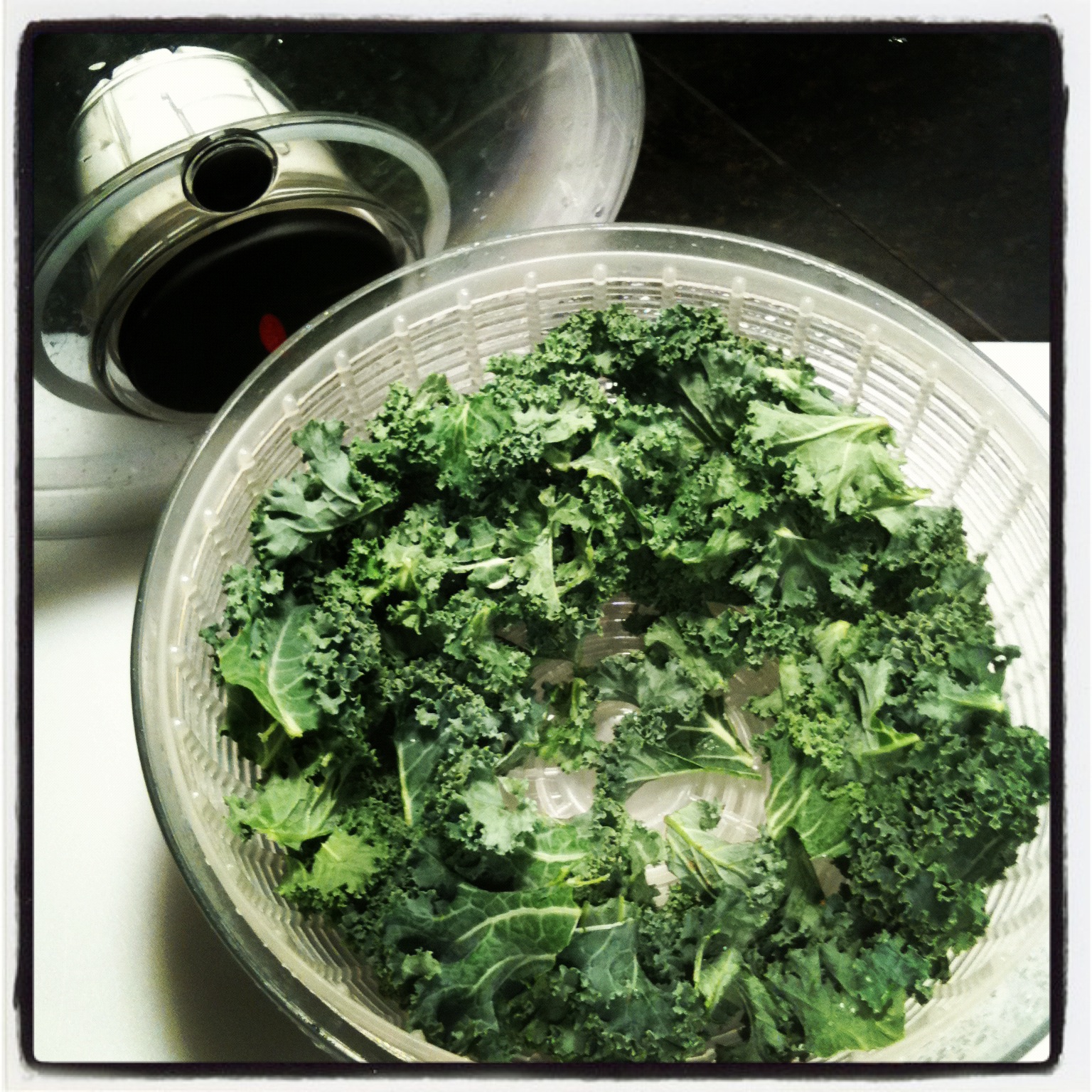
(above) one bunch Organic Curly Green Kale

(above) Remove Kale from stem

-Discard stem-

Washed then dried with Salad Spinner (above)

My son’s favorite Olive Oil, because it doesn’t taste too Olive-e.

I used a small amount of this Sea Salt.

– A couple turns from my Salt Mill.

Here is a comparison photo,

Cooked Kale chip (left), raw Kale (right).

ENJOY!

Are You Dehydrated?

Dehydration

I wake up to CBC radio in the morning. On occasion Dr. Peter Lin joins the morning program for a brief comment on health. His segments are great.

In this mornings’ segment, Matt Galloway from CBC chatted about a new study with Dr. Peter Lin about recognizing the signs of dehydration and the steps to take to ensure staying well hydrated.

Click this Thirsty? link to listen to the audio segment in its entirety. A quick and informative listen at just over 3.5 minutes.

A brief outline of the segment:

  • even very mild dehydration can affect your mood, energy level, cognitive function and memory…
  • 1 – 1.5 pecrent dehydration is considered very mild dehydration
  • we begin to feel thirsty by 1 – 2 % dehydration
  • the body is 60 – 70% Water
  • the brain is 85% Water
  • the brain is our most sensitive organ, so it begins to feel the effects of dehydration first
  • both genders complained of headaches, feeling tired and having difficulty concentrating
  • both genders become cranky with even very mild dehydration
  • Gender differences – Women’s mood worsens; Men’s short term and working memory worsens
  • Researchers think that this ‘making you feel lousy’ symptom is our signal to get more water – This is not the thirst signal
  • The thirst signal kicks in later, by 2% once we become more dehydrated
  • We may be able to turn the thirst signal off, much like turning off our hunger feeling (so we must take care to be mindful of not becoming even mildly dehydrated)
  • One theory of why we begin to feel lousy is that this change in mood may encourage us to go look for water

How much water should we drink per day?

  • It is variable depending on individual activities
  • Generally – 8 cups (2 Litres) per day
  • Of course, the more active you are, the more water you will need
  • Men, average: 3 Litres, including all liquids per day
  • Women, average: 2.5 Litres, including all liquids per day
  • Experts suggest not to count the number of litres but rather:
  • Focus on going to the bathroom (urinating!) at least 4-6 times per day
  • Urine should be pale yellow colour NOT dark yellow
  • However, first urine of the morning will be darker in colour due to night-time/ sleep dehydration
  • Sipping 10 ounces of water first thing in the morning will help to rehydrate the body from the night

Drink some water with meals, because the water does help with digestion. But not too much. Everything in moderation. I tend to drink my 10 ounces of water at the end of my meal. Experiment for yourself and see what works for you. Try all the possible combinations and make your own assessment.

Dr. Peter Lin, also says that drinking hot water is a better choice at meals because the heat helps to cut the grease.

Coffee and tea are ok in small amounts, it counts as water, but when you get to six or seven cups you begin to lose more water than you are taking in, which is the same for alcohol – it causes dehydration.

The best approach is to sip water throughout the day. Gradually increase your water intake over a number of days rather than guzzling down 2 Litres if you’ve barely been drinking any. Go slowly, let your body adapt to the change. Analyze how you feel – some days you will need more water intake than other days.

Remember…

YOU are an experiment of one!

10 for 10 Workout

This was my workout for today.

Ten different exercises in 10 minutes.

After I designed this workout and re-read it, I actually said out loud, “this is going to be tough.” And it was, but in a good way. But funny how now that I’m sitting here writing it out for my blog, it seems like a distant memory. Get the workout done and move on – my body maintenance isn’t an event anymore, it’s required, just part of being here.

Warm up 

  • roll out ITB with Travel Roller
  • 10x flights of stairs by two’s going up and single steps going down
  • light stretches.

Set timer for:

10 Rounds of two intervals to equal 10 minutes

  1. 10 seconds Rest interval
  2. 50 seconds Maximum Effort interval

Each exercise will be performed only once through, which is one of my favourite styles…do it right the first time because there’s no second chances. Which, in my opinion is good training for life!

1. Dynamic Squat: 34

2. Chin Ups (reverse grip – palms face body): 11

3. Sandbag Tap Down (alternating legs): 32

    • I used a household step stool
    • I turn it around so the little step is out of the way
    • Start standing with both feet on top
    • Hugging sandbag above chest – parallel to floor
    • Step down w/Right leg- tap right foot to floor – return right foot to top of step
    • Step down Left leg – tap left foot to floor – return left foot to top of step
    • Each tap down counts as 1 rep

4. Feet Elevated Push Ups: 25                                               (my feet were elevated on a 24″ plyo box)

5. Straight Arm Hanging Leg Raises: 12

6. Prisoner Jump Squats: 25

7. Bicycle Abs: 60

8. Santana Push Ups: 12  (each push up counts as 1 Rep)

9. High Knees: 133

10. Burpees: 10

Cool down w/ 4 x 100 reps skipping w/rope

+ 45 minutes Ashtanga Yoga

  • approx. 20 minutes Standing Series
  • approx. 20 minutes Seated Series (first 12 seated postures including 3 backbends)
  • approx. 5 minutes closing sequence – no inversions + Savassana

Post workout meal:

  • Water
  • Real unprocessed Turkey slices
  • Fresh steamed curly green Kale (re-heated from last night)
  • Roasted Butternut squash + sweet potato w/ginger – chili peppers – cilantro – green onion – lime juice (re-heated)
I think anyone can try this workout, but at their own level.
  • If Chin Ups are just not happening you can simply practice hanging with straight arms from the bar – that alone will start to develop the strength needed to build up to the actual chin up.
  • No chin up bar? Leave it out and make it a 8 for 8 Workout.
  • Modified Push ups instead of feet elevated…maybe even just doing the wall press.

My point is, that there is always a way to modify any workout to suit your individual level. You can cut out exercises and make a it a 5 for 5 Workout…etc.

When I get some time I will add some links and hopefully more pictures to make the workout more clear.

Bed Stretches #2

Dansk: Sibirisk tiger (Panthera tigris altaica...

These are the stretches that I do first thing

in the morning.

First thing every morning, before my feet hit the floor I do a series of stretches in bed. View Bed Stretches #1 for the introduction.

This is the second video in a series of progressions showing a very short in-bed-stretching routine that I do every morning. It may offer some ideas to start exploring your own options for a morning routine. It’s a good idea to develop a similar habit everyday for the rest of your life. The point is to do what feels right for your body – not what feels right for mine!

Some people might find that starting with holding the knees to chest is more than enough to take on first thing in the morning. That’s fine. Do what works for you. One thing we know for sure, is that we have to move in order to be able to move. So, I’d like to encourage everyone upon waking to get the fuzz out and “keep moving, stretching and using your body.”

This second video offers a quick review of the first two stretches/exercises:

  1. hold knees to chest
  2. single leg hip flexor stretch (right & left)
And each new video features an: Adding on… section:
        Video #2 introduces bicycle legs to ceiling.


Explanation:
  • Bicycle legs to ceiling is an exercise, which actively stretches our muscles gradually and gently.
  • As our muscles warm up from this repetitive action we stimulate oxygen and blood flow to our entire body.
  • I focus on working through my feet, stretching and leading the movement up to the ceiling with my heel.
  • When I first included this exercise I only did about 20 repetitions – and it seemed like a long while before I added on.
  • Using my duvet supports my sleepy, inflexible morning body so that I don’t end up gripping my back to hold my legs up.
  • Approximately, one year later, I naturally do one hundred repetitions (counting by 10’s) – Good mental exercise to wake the brain up too!
  • It takes fifty repetitions for me to wake up and the second set of fifty has purpose!


It sure is a nice feeling to step out of bed rather than crumble out.


NOTE: These Bed Stretches are meant to be a very gentle way of waking up the body. In no way should this routine be considered a workout or performed aggressively. 

I repeat, they should be done very gently. Keep knees bent, this is not a performance routine and knees should remain bent, even if you can straighten them during the day when you do the same type of movement.

Also Note: That when I filmed myself doing these stretches it was already afternoon and my body was very warmed up. First thing in the morning I do NOT move as fluidly; my body feels very rickety and stiff, besides feeling half asleep. Sometimes, I take the stretch and fall back asleep for a few seconds in the stretch! And abruptly wake up – oh, yeah – where was I?


It’s just a nice way to start my day.

Bed Stretches #3…coming soon.