Body Maintenance

video/Week#3-DAYS 1 & 4

Here is week #3 – DAYS 1 & 4

My nephew Peter is demonstrating.

Week #3

Carry on repeating Weeks #1 or #2 if you do not feel ready to move on to Week #3.

Week #3 is for those who have done last weeks’ prep exercises.

By now you should feel quite familiar with Marching On The Spot and getting your knees up high.

This week we will be progressing to High Knees.

To begin this progression you need to start with gentle bouncing from one foot to the other.  Already, I can hear some of you saying, “nope – this isn’t for me”.  Which is completely fine; stick with Marching On The Spot until you are ready to give it a try.  For the others, resist the urge to skip ahead.  I know some of you want to get to the tougher exercises, but believe me your body will thank you if you take it one day at a time.  This is an exercise in patience for the Ego too.  We are doing these exercises in bare feet, but, of course wear running shoes if you have a pre-existing condition which requires you to do so during exercise.

Reminder:  Be mindful of your feet and arches.  The following exercises will be more taxing and it is easy to lose focus and just want to get to the end.  Try to be present and mindful of each repetition.

NOTE: If doing one round feels challenging enough then stick with one round until you feel comfortable adding the second round and so on.  Listen to your body. 

Days 1 & 4 (week #3)

  1.  50 Marching On The Spot.                                                                                           Place your arms tight by your sides.  Now bend at the elbow creating a 90-degree angle. (Arms point forward). Your forearms are now parallel to the ground.  Keep your forearms still with palms downward).  Each time you March a knee up, make your knee touch your hand.  Do NOT lower your hand to contact your knee.  Bring your knee UP to touch the hand.
  2.   20 Bend Down & Reach Ups with Toe Raise
  3.   Repeat circuit 4 times to equal 4 rounds total.
Note: The effect of keeping the forearms still as opposed to pumping the arms makes the exercise slightly more challenging.  The pumping action of the arms actually helps to move the legs.  Notice if you can feel the difference.  Also, each time you lift your knee up you are strengthening your abdominals.

video/Week#2- DAYS 4-7


My nephew Peter is demonstrating.

This video is for DAYS 4-7 and is the same from DAYS 1, 2 & 3.  The only difference is that you will be adding 2-3 repetitions each day for the Bend Down & Reach Ups with Toe Raise until you get to 2o repetitions by Day 7.

Alternately, you can continue with Days 1, 2 & 3, which is as follows:

  1. 50 Marching On the Spot (knees up high).
  2. 10 Bend Down & Reach Ups
  3. Repeat circuit four times, to equal 4 rounds.
If you choose to add 2-3 repetitions of Bend Down & Reach Ups with Toe Raise each day then that progression looks like this:

Day 4
1. 50 Marching On the Spot (knees up high & pumping arms).
2. 12 Bend Down & Reach Ups with Toe Raise
3. Repeat circuit four times, to equal 4 rounds.

Day 5
1. 50 Marching On the Spot (knees up high & pumping arms).
2. 15 Bend Down & Reach Ups with Toe Raise
3. Repeat circuit four times, to equal 4 rounds.

Day 6
1. 50 Marching On the Spot (knees up high & pumping arms).
2. 18 Bend Down & Reach Ups with Toe Raise
3. Repeat circuit four times, to equal 4 rounds.

Day 7
1. 50 Marching On the Spot (knees up high & pumping arms).
2. 20 Bend Down & Reach Ups with Toe Raise
3. Repeat circuit four times, to equal 4 rounds.

For whatever reason, if you’re not ready to add on then stay with what is working or go back to the beginning.  Listen to your body.

Check back for Week #3.

video/Week #2-DAYS 1, 2 & 3

My nephew Peter is demonstrating.

By the way, it’s ok to repeat Week #1 as often as you like. Our main focus is to develop the self-discipline to be consistent.  So often people tell me that they are so caught up in their lives that they just can’t fit in their usual one or two hour workout.  And so they end up going without any exercise until their schedule clears up.

As the Dude would say: “This will not stand”.

Days 1-2 & 3 (of week #2) are the same as Day 7 (from week #1). The only difference is that you will do a toe raise when you reach up to the ceiling.  We are doing these exercises in bare feet, but, of course wear running shoes if you have a pre-existing condition which requires you to do so during exercise.

Days 1 – 2 & 3 (week #2)

1. 50 Marching On the Spot (knees up high & pumping arms).
2. 10 Bend Down & Reach Ups with Toe Raise
3. Repeat circuit four times, to equal 4 rounds.

The effect of the toe raise, is to gradually strengthen the arches of the feet and develop balance. Notice what happens when you rise up onto your toes. What happens to your arches? What happens to your balance? Do you lean more onto one side than the other? What do you have to do to remain centred?  Do your ankles roll out?
So often the feet are forgotten when we exercise the body. The foot, being the foundation of our body, directly impacts the rest of our body’s alignment.

Whether you are just beginning to contemplate my 4 Minute Mornings or are a seasoned athlete, stand in front of the mirror and take a look at your feet and arches.
While exercising or just walking around, I would like you to bring some awareness to your feet.  Better yet, have someone video your feet as you rise up onto your toes and lower back down.  Watch the mechanics of your feet.

The link below is a two-minute video clip featuring Jesse Enright, from Smart Yoga, describing the three arches of the foot. Yes, there are three arches!

http://www.myyogaonline.com/search?q=jessie+enright

Click the video for: Smart Yoga For The Foot.


video/ Week #1 – DAYS 5, 6 & 7

Here is week #1 – DAYS 5, 6 & 7

My nephew Peter is demonstrating.

Days 5, 6 & 7 (~4 Minutes each)

  1. 50 Marching On the Spot (knees up high).
  2. 10 Bend Down & Reach Ups
  3. Repeat circuit four times, to equal 4 rounds.

Depending on your speed/pace, this circuit (repeated 4 times) should take about 4 minutes.

Note: If you’re not ready to move on to four rounds then repeat Day 4 and add on when you are ready.  

video/ Week #1 – DAYS 3 & 4

Here is week #1 – DAY 3

My nephew Peter is demonstrating.

Day 3 (~1 Minute)

  1. 50 Marching On the Spot (knees up high).
  2. 10 Bend Down & Reach Ups

BEND DOWN & REACH UPS: Begin standing with legs and feet together. Bend down at the knees and hips (feet stay flat on the ground –like squatting on a very low stool, chest lifted.  Touch the ground with your fingertips (or just as close to the floor as possible), then straighten up to standing.  Reach arms up to ceiling.  Repeat.

Day 4 (~2 Minutes)

  1. 50 Marching On the Spot (knees up high).
  2. 10 Bend Down & Reach Ups
  3. Repeat circuit twice, to equal two rounds.
Note: If you’re not ready to move on to two rounds then repeat Day 3 and add on when you are ready.  


video/ Week #1 – DAY 2

Here is Week #1 – DAY 2
My nephew Peter is demonstrating.
Still getting the hang of filming.  The dog was a bit distracting so I lost count a few times.

Day 2 (approx. 2 Minutes)

  1. 50 Marching On the Spot (knees up high).
  2. Rest 10 seconds

       Note: 50 Marching on the Spot + 10 second Rest = one circuit.

3.  Repeat this Circuit 4 times, to equal 4 rounds.

Note: you should be able to do 50 Marches in approximately 20 seconds.  If it takes you longer than 20 seconds that’s fine.  You don’t have to do all four circuits if you’re not ready.  Build up to it at your own pace.  Keep a log of what you do so you can monitor your progress.  Each knee up counts as one repetition.

Video Week #1 – DAY 1

Finally, here is Week #1 – DAY 1
My nephew Peter is demonstrating.
I forgot the sound on this video…that’s why Peter is just standing still for about 10 seconds at the beginning.
Day 1 (approx. 1 Minute)
  1. 50 Marching On the Spot (knees up high).
  2. Rest 10 seconds
  3. 50 Marching On the Spot (knees up high).
  4. Rest 10 seconds

Note: you should be able to do 50 Marches in approximately 20 seconds.  If it takes you longer than 20 seconds that’s fine.  Keep a log of what you do so you can monitor your progress.  Each knee up counts as one repetition.

Body Alignment

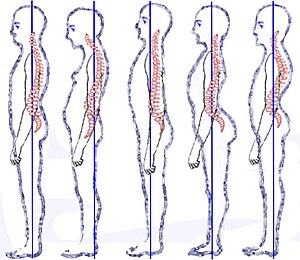
Posture types (vertebral column) classificatio...

Image via Wikipedia

Body Alignment and Exercise

It’s important to have good body alignment, not just when we exercise, but whenever we move our body.  When our muscles contract they pull on the tendons, which move our skeleton.

Good body alignment supports efficient muscle contraction, which in turn supports our balanced skeletal structure.  We cannot have one without the other.

Aside from the proven physiological health benefits associated with exercise, the entire point of exercise is to strengthen and stabilize the skeleton enabling it to function effectively.  Not paying enough attention to this basic principle loads too much pressure or stress onto unsuspecting joints, pulling us out of functional alignment, which can lead to pain or injury, and sometimes an unflattering physique.

The primary reason most people exercise is to look better and improved health takes a close second.  If our goal is to look better then why do we punishingly force ourselves to execute movements without paying attention to how they are performed?  It’s because we are thinking too much on completion as opposed to the precision of movement.

Most people I know are hard workers and are willing to try just about anything for the end result.  But what if all that hard work turns out to be for nothing?  What if mindless or forced repetition with poor body alignment is causing more damage than good?

What is the solution? Like any type of movement, if you do not know what correct body alignment is, how can you monitor yourself?  Enter the domain of the expert: Personal Trainer, Physiotherapist, Registered Massage Therapist etc. These professionals reinforce, remind, and educate the client on proper technique and body alignment, be it for daily function or athletics.

Clearly I am biased, but in general, I believe in learning from an expert.  And it is quite clear how I feel about putting health first.  We all know that without our health we have nothing.  Unfortunately, it is often the case that before we come to this realization and do something about improving our health, we suffer serious illness or injury.

The following is from personal experience as an example.  Having taken the mandatory swimming lessons in public school, I have always been able to swim at a recreational level.  Two years ago I joined a masters swim group, which met once per week for an hour of drills and stroke improvement.  Being a ‘land athlete’ all my life I was nervous about joining this group, but getting over this fear and really learning how to swim was another goal to strike off my to-do list.

When refining or learning something for the first time, there are many layers and many A-HA! moments along the way.  So, what does any of this have to do with body alignment?  In a group class there is only a certain amount of individualized attention a coach or trainer can give each student.  As a beginner swimmer, the amount of feedback I got from my coach was more than adequate.  However, as I put these corrections into practice, I developed some elbow and shoulder joint irritation.  I started swimming a second day a week (for half an hour) at a moderate intensity, just to practice these corrections.  I later found out, that I misunderstood some of the corrections and was doing something else entirely wrong.  But this is what I am talking about when I give the ‘layers’ analogy.  We learn more and make progress, only to discover there is an entire other layer of lessons waiting, and more lessons beyond those.  Learning is an endless process, which for me is what makes learning so exciting.  I cannot imagine it would be very fun if we did everything perfectly the first time.

When checking in and complaining about these new pains with my registered Massage Therapist, it was he who identified the problem and was able to give me direction as how to correct my technique.  What is fascinating to understand is that my technique was faulty because of a very small, over-tight, muscle (teres major), which affected the mechanics of my shoulder from rotating properly.

About five months ago I stopped going to the masters swim group and instead started meeting a swim coach once every three weeks for a half hour of technique drills.  The rest of the time I have to be strict about going to the pool to practice on my own.  The point is that without these individual lessons that focus on my particular needs, and the support from a registered Massage Therapist, I would continue to irritate my elbow and shoulder joints because of the high frequency of incorrect repetitive movement.

This brings me to my second point about short-duration training.  None of us can expect to push our bodies for long periods of time without losing form as a result of fatigue.  Generally, a person who is more fit can train longer, but it is still possible to be fit with poor technique.  It all comes back to balance.  Are you stretching enough to counter all the strengthening and tightening?  Are you stretching properly?  Are you forgetting to stretch some parts of your body just because you don’t know how or because you don’t even know they exist?

In a nutshell: focus on precision of movement.  Exercise consistently and for short periods of time.  Stretch your body daily.  Get professional advice and support from certified and registered practitioners.  And most importantly give your body ample time to rest and recover between intense workouts.

Stretch Your Body

Stretching exercises

Stretch Your Body every day.  Do Yoga, Pilates, traditional sports stretches or other.  Whether you spend 4 minutes or an hour or more a day stretching, when done properly, your body will respond positively to the attention.  Too much focus on tightening and strengthening without lengthening the body’s musculature and connective tissue can have a negative effect.  Likewise, it is easy to overstretch areas that are already flexible leaving the problem areas unattended.  I did exactly that in my early twenties, which caused a very painful knee condition called chondromalacia.  I recovered from it with a lot of help from physiotherapy and massage.  I learned a lot in the process.  Doesn’t it always seem that we learn best from painful personal experience.  I spent a lot of time doing rehabilitative stretching and strengthening and walking around with ice packs strapped to my knees.  As a result stretching has played a significant role in my body maintenance routine ever since.

I highly recommend seeing a professional for advice specific to your individual needs.

I believe that therapeutic massage, myofascial manipulation and active-release therapy among other techniques are necessary to support our over-worked, over-stressed and over-exercised bodies.  I think that most people view massage as a luxury, something to do while on holiday or at a spa rather than as a form of body maintenance.  To get the most from any type of physical therapy, one must collaborate with the therapist as a working relationship.  Tell your therapist that you are keen to make improvements, so ask questions.  Work with them to figure out what type of repetitive movements (or lack of) might be contributing to your muscle soreness or joint pain for example.  Do not leave their office without at least one stretch that you will practice daily.  Careful not to overwhelm yourself with more than three stretches at a time, because you probably will not do them.  The next visit the therapist can reassess and give you another stretch to work on.

I know not everyone can afford massage therapy, I guess that is why it still falls in the luxury category.  But, you can access affordable massage by looking up the teaching colleges.  The students need real bodies to practice on and the price can be very affordable so that you might be able to make it a monthly appointment.  My Registered Massage Therapist did her training at WCCMT and can vouch for its credibility.  They have a student clinic that you can check out as an example. www.collegeofmassage.com/newwestminster/

I haven’t been to Utopia Academy in Vancouver, but as another example of what a student clinic is like, you can check it out here. www.utopiaacademy.com

Fuel

Farmer plowing in Fahrenwalde, Mecklenburg-Vor...

The modern world has a strange relationship with food.

While early humans foraged for survival, modern civilization indulges in the increased production and availability of food, which has enabled us to focus our attention on other pursuits.

Food has become an affordable disposable luxury item for the developed countries, while the majority of the third world’s population cannot get enough to eat.

How is it that we over-eat until we feel sick then do it all over again? It is a cruel Pavlovian reflex.

We eat or drink to celebrate.  We eat or drink because we feel we ‘deserve’ a treat or as an emotional response.  We eat or drink to be social or to ‘fit-in’.

And sometimes we do not eat enough with the hope to control our weight.  Both extremes can leave lasting negative outcomes.

 In his book How to Be Compassionate, The Dalai Lama says:

“There are many discrepancies between the way things appear and the way they really are.  Something that is impermanent can appear permanent.  Also, sources of pain, such as overeating, sometimes first appear to be sources of pleasure, but in the end, they are not.  They actually bring us trouble.  Although we want happiness, in our ignorance we do not know how to achieve it; although we do not want pain, we misunderstand its workings, so we end up contributing to its causes.”

This can also be the case with exercise. Pushing so hard, not taking enough time for the body to rest and recover to the point of developing stress fractures; knowing better but not listening to your inner voice or the physiotherapist for that matter.

Can you find a parallel in your life?  Something that you do in excess or even in what might seem like a negligible amount that you know is harming you or will harm you in the future?

Will you stop this cycle?  Do you want to?

Were you able to stop this cycle?  How did you do it?