health

Rx FOOD

“There is no ONE GIANT step

that does it,

It’s a lot of LITTLE STEPS.”

To date, I’ve been experimenting with food as medicine for a solid year and a half.

In a recently published post, titled: My Hernia, I described my experience with an umbilical hernia, and by the end of the article I commented on the fact that some exercises can be useless. Which triggered another thought…how certain foods can actually be useless too.

There are a lot of fancy exercises that are in vogue these days, that fall into the useless category causing more harm than good. Now, this is assuming we know better but keep on repeating them, regardless. However, because it’s unlikely that doing the occasional useless exercise likely won’t cause much lasting damage, it begs the question, then WHY would we do them in the first place? What is our motivation behind doing things that are useless? Our best bet is to stick with the basics, but also to work with an expert who can identify which basic exercises will actually be beneficial for our specific needs. (Collaborating with an RMT trained in Rolfing [Structural Integration] or KMI / Myofascial Release is my first choice). Sure, we can go ahead and do exercises, which are not appropriate for us and survive…(clearly, there are worse things we can do!). But, from my perspective, if we’re going to bother in the first place, doesn’t it make sense to at least try to do it right? Getting to the point of doing it right can take a lot of trial and error and a lot of research; if we’re too busy to learn and grow, then what are we here for? I have come to have this same opinion about food as a result of exploring which foods actually support my health. We can go ahead and eat anything for energy, but if we’re going to bother, doesn’t it make sense to do the research and fuel ourselves accordingly to actually enhance our health?

…Prescription Food, as I’ve come to think of it.

Why not?

I met Sandrine at my daughter’s school about three years ago. Our daughters have been in the same class over these few years and so naturally, we have had many opportunities to chat. And as parents often do, we talk about our daughters; their talents, milestones and of course the challenges: the sleepless nights, the food sensitivities/ allergies, which doctors 😉 or finding THE magical balm to soothe irritated skin, etc. – You get the idea.

Sandrine went the distance like no other to help both of her daughter’s with their skin issues. She had eliminated certain foods from her girls’ diet in the hopes that that would help. She would go so far as delivering fresh homemade meals to her girls everyday at lunch so they could stay true to their program. This kind of effort puts tremendous strain on a parent; anyone raising a child with allergies or food sensitivity knows only too well what I’m talking about.

Six months into my experiment with ER4YT, I happened to be chatting with Sandrine at our girls’ first chess tournament. Since Sandrine and I share a similar interest in following current news regarding health, our conversations often revolved around comparing notes on such topics. I told her about ER4YT and my suspicions about gluten causing my joint inflammation. She considered looking into it as a possibility for her daughters. Sandrine is a researcher…she will leave no stone unturned. Months later, once back to school in September, I sidled up to her to get an update on the skin issues…because when I greeted her daughter, it was quite evident the skin issues were no more.

“Soon after my child was born, I knew that it was food which contributed to her rashes and other issues.  The skin tests did not reveal food sensitivities, but food allergy.  However, avoiding the foods my child was allergic to did not bring relief, in fact, it got progressively worse over the years.  When I asked for their advice, Allergists and Dermatologists talked about elimination diet and its challenges. Recently, after almost nine years and two kids later, I discovered ALCAT testing.  ALCAT and our naturopath transformed my children’s life and naturally mine. With ALCAT, we are confident in what they can and cannot eat.  The recommended rotation diet along with the ALCAT test meant no more rashes or eczema, bleeding wounds from scratching, thick dandruff on the scalp, sleepless nights due to scratching, respiratory congestions, fatigue and failure to thrive.  Today, my kids are not only doing well, but thriving, all without the need for medicated ointments and medications.”  -Sandrine


This is an incredible story, and yet, elements of it are universal.

I know most of you reading this don’t know me and at this point are genuinely wondering if I am advertising for ALCAT or ER4YT. With all sincerity, I promise you that this is an information sharing website only. I do not have any affiliate codes associated with any of the links found on my site and am not receiving and discounts or support from the practitioners with whom I consult.

Any pop-up advertising you may see on my site from time to time is generated by WordPress, my host, who benefits from it in order to keep the operating costs down.

Sandrine did her research and took the blood type philosophy to the next level by actually having both her daughters and husband’s blood tested by ALCAT. Seeing her success with the program I am considering trying ALCAT testing for my family too. Right now, however, we are going to go the distance with ER4YT because we are still in the infancy with our exploration. My husband and I have done the Secretor Test, which helps to fine tune our beneficial food lists (I am blood type O+, Non-Secretor, my husband is AB-, Secretor). My kids will be taking the Secretor test next week – we are all curious for the results. My kids are becoming more and more interested in taking care of their health, now, and beginning to understand the significance of NOW, and the impact it will have on their adult health. Many people falsely believe that children can eat and drink whatever they want. They believe that kids will figure it out for themselves like so many of us did. I say, look around…there is an entire population plagued with an inability to figure it out for themselves. Our health will not fix itself. Raising kids on candy and sugar and processed foods is damaging, period. There is absolutely nothing beneficial or nutritious found in those products. But what if you’re like Sandrine or myself, who make every attempt to nurture healthy habits by introducing nothing but whole foods to our babies, to then being completely mystified that those supposedly healthy, super foods are not tolerated.

Yes, we can eat anything. We can drink anything. Most of us know of, or may even be related to people who do not espouse a healthy lifestyle in the least, but are still living- against all odds. You know, like James’ uncle who each day smoked half a pack of cigarettes, drank like a fish and never exercised, but lived to be 102. Mind you living a long time and living well for a long time is a horse of another colour. I often wonder what the longevity might have been for people like James’ uncle had they taken care of themselves?

I know a man in his mid-seventies who has been Diabetic (type 2) for thirty years. For many years when he had kept his Diabetes ‘under control’, his weight had stabilized at 200 pounds, which seemed like an acceptable weight for a man at a height of six-feet. He is currently sixty pounds over that weight. It seems like his weekly schedule is busy with regular check-ups with his doctors or advisers. When I ask him how he’s doing, he tells me that his doctors tell him that he’s doing OK. This frustrates me, so I ask him gently, “How can you be OK, when you are 1) Diabetic and 2) sixty pounds overweight? You are NOT OK.  This is unacceptable.” He continues to do the same thing he has always done, which rewards him with the same results he’s always gotten. No change to his health; just a slow decline. He tells me, “Well, we’ve all got to go sometime.” This is true, none of us is getting out of this life alive.

But there is a huge difference between accepting our fate and having the belief that there is no fate but what we make.

“Since the dawning of the Age of Genetics, we have been programmed to accept that we are subservient to the power of our genes. The world is filled with people who live in constant fear that, on some unsuspecting day, their genes are going to turn on them. Consider the masses of people who think they are ticking time bombs; they wait for cancer to explode in their lives as it exploded in the life of their mother or brother or sister or aunt or uncle. Millions of others attribute their failing health not to a combination of mental, physical, emotional, and spiritual causes but simply to the inadequacies of their body’s biochemical mechanics. Are your kids unruly? Increasingly the first choice is to medicate these children to correct their “chemical imbalances” rather than fully grappling with what is going on in their bodies, minds, and spirits.

Of course there is no doubt that some diseases, like Huntington’s chorea, beta thalassemia, and cystic fibrosis, can be blamed entirely on one faulty gene. But single-gene disorders affect less than two percent of the population; the vast majority of people come into this world with genes that should enable them to live a happy and healthy life. The diseases that are today’s scourges – diabetes, heart disease, and cancer – short circuit a happy and healthy life.

These diseases, however, are NOT the result of a single gene, but of complex interactions among multiple genes and environmental factors. “

Bruce H. Lipton, PhD – author of Biology of Belief            (quote from pg. 20 -21)

I understand that our doctors only have about 5 – 30 minutes with each patient (the upper number if you’re lucky!) and it is equally frustrating for health care practitioners, because as much as they want to eradicate disease, their hands are tied. Patients MUST help themselves and be more than a willing participant who accepts pharmaceuticals as their cure.

There are so many websites promoting miraculous cures, from natural supplements, water purification systems to products or equipment. It’s easy for any consumer to be charmed by all the claims often accompanied by glossy photographs of eye-catching perfection. All these advertisements remind me of the traveling-snake-oil-salesmen from the 19th century – Are we still being duped? Clearly, the only way to know for sure is to experiment for ourselves (with caution!).

Having said this, most of us are skeptics and require a lot to convince us to buy a product. But isn’t it interesting that when we finally do decide to jump in, and put our whole belief into something, we become a self appointed spokesperson for said product. As if, because it might work wonders for us, we think everyone else should try it too.

Listen, I don’t know exactly what works for me. I’m still figuring things out. And it seems to always be that once I get a handle on what seems to work my body goes ahead and ages, bringing on new changes and challenges. We are in a constant state of change. I believe we have to stay alert to these changes and adapt to them.


KEEP

CALM

AND

ADAPT

to CHANGE


In writing this post it is my hope to encourage others to consider that: because none of us know anything for certain, that we have to try and keep trying and not sit back accepting our ‘fate’.

For those interested in exploring Prescription Food for Our Individual Health, I have imbedded the links to the sites that I have personally explored. I have done Dr. Mercola’s Nutritional Typing questionnaire, which pegged me as a Protein Type (which is very similar to ER4YT, just without the blood typing). One thing that I took away from Dr. Mercola’s site that I have been experimenting with is: the order in which I eat my beneficial food.

Dr. Mercola says:

“In addition to eating the right foods for your body, believe it or not, we discovered that it is not enough just to make the right food choices…It is equally important to eat your foods at each meal in the right order!


  • Many leading protein types should eat their meat first.
  • Carb types should eat their vegetable first.
  • Mixed types should eat their meat and vegetable together.

When your food is consumed this way, digestive and nutritional efficiency will improve dramatically, shown by:

  • Improved meal satisfaction.
  • No need for snacks between meals.
  • No more food cravings.


Dr. Mercola has a basic Nutritional Typing Plan. Click here to view Dr. Mercola’s Nutritional Typing.

ALCAT Testing Website: ALCAT

Eat Right 4 Your Type website: Eat Right For Your Type

ER4YT: Secretor/ Non-Secretor Information page

ER4YT: Salivary Secretor Test Kit


In addition, this 5 minute video presented by HU Medicare Local, Australia talks about Understanding Pain. There is a lot we can do for our own self-care. Whether we live a long or short life, I think that we can all agree that the best choice would be to live out our days at a healthy weight, without pain or debilitating disease.


This goes out for anyone struggling with mental, physical, emotional or spiritual challenges…I care about your well-being and hope that the information in this post will be useful for your exploration. Just try and keeping trying.
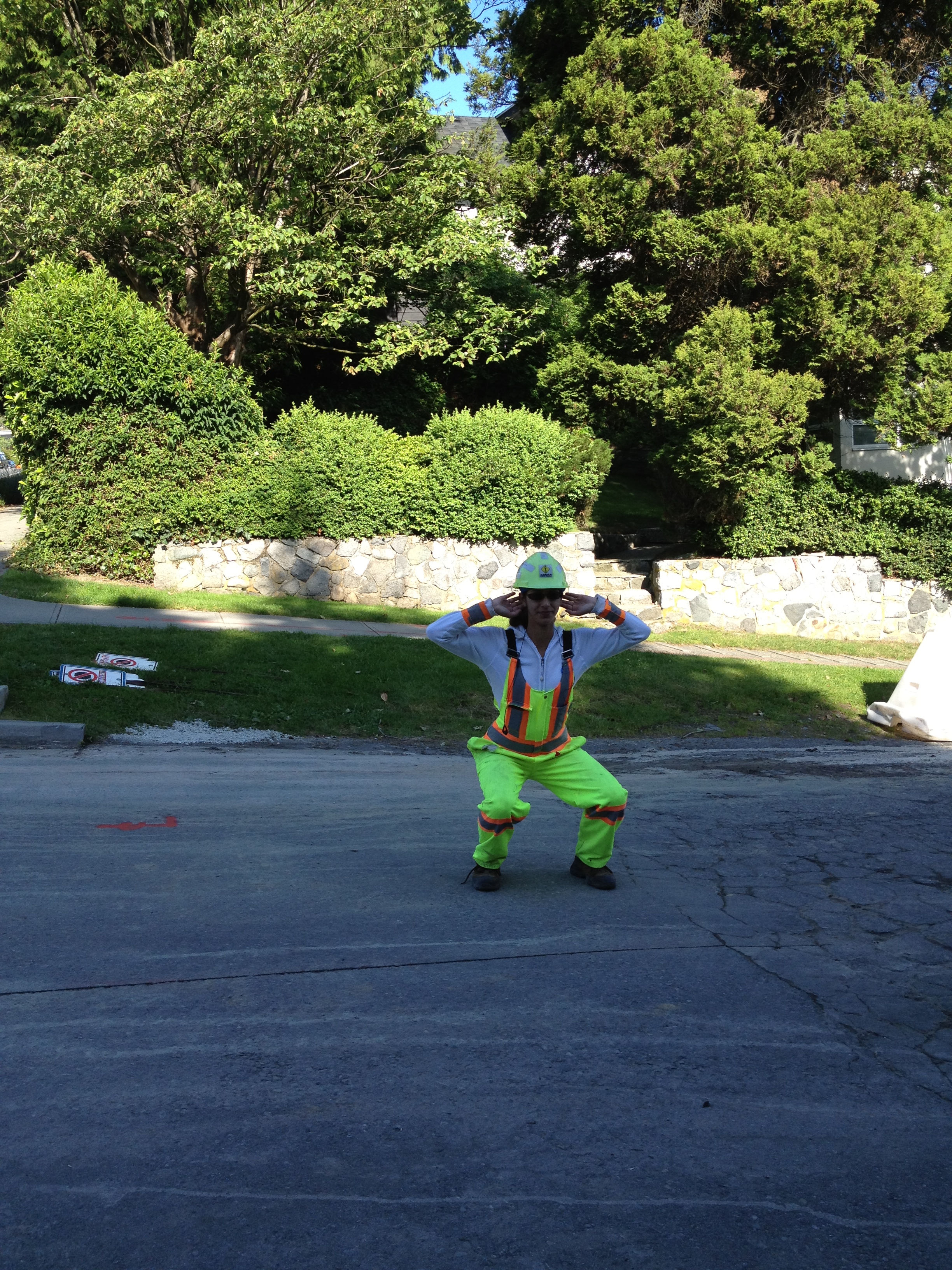


Flag Girl

This is Flag Girl Amanda.

Driving home from my 10 minute morning hill sprint with dog Ruby and my 9 year old son, I happened to see Amanda doing some Prisoner Squats at the side of the road.

Amanda is a Flag Girl with the city’s sewers crew. I parked my car and high tailed it over to chat with her about what she was doing. With my son and dog in tow, I told her what I had witnessed. She explained that she had been in a motor-vehicle accident on March 27, 2012 and since has been in a lot of pain. She had gone through all the required active rehabilitation for the soft tissue damage. However, since the physical treatments that were covered by insurance had come to an end she had to become self-sufficient and consistent with doing the prescribed exercises throughout the day on her own. She quickly showed me the list of exercises on her phone.

Yay, Amanda!

Because her job requires for a lot of standing she finds that the immobility is what contributes to her pain. As a result she does whichever exercises she can while on the job.

I can’t tell you how happy I was to see this. On one other occasion I noticed a Flag girl doing some lunges and now wonder if it was Amanda then also!?

I’ve often wanted to contact the city and offer to give a workshop on how workers can help themselves throughout such long days of mostly stationary work – because standing around (though at least there is movement), can be equally difficult on the body as sitting at a work-station all day. In addition, I think that long hours, like what Amanda does can often leave workers fatigued by days end and the last thing they want to or feel motivated to do is think about doing a ‘workout’. So what if people in this situation could be shown (and convinced) that some, focused exercises done with precision, specific to their needs could do a world of good!

This is why I love the 4 Minute Morning concept as well as Stretch B4 Bed idea too. Each session doesn’t have to be an event, but rather a few minutes of focused attention, a moving meditation, which is what Yoga is; time spent inwardly focusing and becoming aware of our physical being, which subconsciously trains our body to function correctly when we are not able to be focused inwardly…like, most of the time!

Here is a little video of what I saw Amanda doing that morning. She re-created the moment for me so I could post it here. Of course, my preference would have been to catch her spontaneously, but this will give you the gist.

I just wanted to reinforce here, how beneficial and necessary micro-breaks are for all of us, regardless of injury or as daily maintenance. I think our culture has gotten a lot carried away with the more is better philosophy with regards to exercise. We need to step back and focus more on how our body functions and less on doing exercise for the sole purpose of looking a certain way.

My Hernia


This post started out as a reply to a comment from AZ. But, because I am still learning to edit myself to say more with fewer words, I have exhausted the allowable space in the comment section 🙂

AZ wrote:

“Thank you so much for a thorough and helpful advice. I really appreciate the time you have taken to respond to me, including attaching the links for easy navigation. Your thought of “saving me time” in attaching the links is recognized and valued. Thank you again very much. I have to come up with some in bed stretching routine that does not involve laying on my back, since as you know, at this point in pregnancy, even that is not allowed 
I am somewhat active still, running around after my toddler and my dog  walking, cleaning, the usual household chores one does, but not nearly as active as in my first pregnancy. I was even using a kettle bell and a medicine ball in the beginning, until I noticed every time I would do a strenuous move or lift, my hernia above my bellybutton would stick out even more, so I decided not to “promote” it’s growth. I will try your suggestions and let you know how it goes. Thank you again, Sincerely,
 AZ”

I realize that the post below may only be interesting to a very select group, however, it is alarming at how common hernia’s are and how unaware most of us are about how they are caused and what we can do to prevent them.

When I was pregnant with my second baby, not only was I uncomfortable during my third trimester, but I also found it very challenging to be pregnant with a toddler in tow. I remember taking comfort, in imagining that things could only get better and more manageable once the second baby was born. Some things were easier, like actually being able to bend down to tie a shoelace. But, while bio-mechanically the body is somewhat like its old self post-partum, other challenges surfaced, like being so tired from lack of sleep and in an effort to keep the calm, always trying to anticipate my toddlers’ actions and emotions in order to be one step ahead of tantrums or falls, etc. I think my nerves were so shot from being on duty 24 hours per day that I often found myself carrying both the newborn and the twenty-three month old simultaneously. I think that feat of strength falls under the heading of over-worked adrenals and the super-human-mommy-survival mechanism. Oh, and managing two Rhodesian Ridgebacks.

All the above, just to tell you, that all that unnecessary lifting (and the tons I did during the second pregnancy – because I could!) may have contributed to my developing an umbilical hernia. The hernia that I didn’t even know I had until the summer of 2010, which was a long time after having my kids.


My navel looked kind of bizarre during and after both pregnancies (2002, 2004), but I chalked it up to just that: two pregnancies is going to leave their mark. Besides, I thought my new outie belly button was kind of cute during my pregnancy! Now that I reflect on it, I find it interesting that none of my health care practitioners noticed it or if  they did, never commented on it. Maybe, because it was so small it really did look just like an outie? I only discovered the hernia after doing a workout, which (similar to you) involved using a Kettlebell for a Turkish-Get-Up or weighted sandbag sit-up. After this particular workout, when for whatever reason, I touched my navel to discover how incredibly sensitive it had become. Suddenly, I noticed how certain movements caused a little pea-sized something to pop out. It left me feeling nauseated!

Unfortunately, a few days after I discovered the hernia, we went on a family vacation to the lake so I had to wait a week before seeing my doctor. I could still do everything, save for certain movements, which caused minor discomfort – though I avoided touching my navel entirely, except for occasionally pushing the little ‘pea’ back in.

Upon our return, I visited my doctor who sent me for an ultrasound. The ultrasound showed that it was only a partial hernia, since nothing had broken through the fascia. A visit with a general surgeon suggested that it looked as though this weakness could very well have been there since MY birth and that the two pregnancies combined with certain exercises and quite possibly the nine months of an intense chronic cough, may have made it worse. Knowing that I was a very active person, the surgeon recommended a basic suture, which would prevent it from becoming a full hernia and it would only leave less than a one-inch scar on the fold of the skin just above my navel. (The idea of the scar didn’t bother me).

The surgeon compared the procedure to going to the dentist; it may be uncomfortable at times but manageable. Post-operation, he said that I’d be able to get back to my regular routine, even exercise (clearly NOT High Intensity Exercise, but able to resume exercise) the very next day! Described like that, I figured that I could handle it considering I endured the pain of two home births. Yeah, go ahead, I can take what you’ve got…It’s funny-peculiar, how enduring the pain of the home births used to mean something to me, like if I could handle that I could handle just about anything. Somehow, I’ve lost my ability to handle certain things, (mostly observing and dealing with others’ accidents), which I won’t digress about here, but believe me I have been found on more than one occasion in a crumpled heap feeling nauseated, moaning for my mommy.

On November 9, 2010, I drove myself to and from my surgery. The surgeon’s description about the simplicity of the procedure was spot on, except that for whatever reason, my body didn’t quite heal as quickly as it should have. Quite possibly, because of my previous tendency for joint inflammation, my recovery lasted nearly ten days, as opposed to the usual three to five days!! It took an additional fourteen days before I could get back to my usual routine.

When I went for my ten-day follow up appointment, my surgeon was genuinely astonished by my experience. Meanwhile, I’d been cursing his name under my breath, wondering what kind of a joker-surgeon had I been dealing with. Ha, Ha, just wait till she tries to do…anything. Muahahaha!!! 🙂

In all seriousness, he was a lovely person and highly respected general surgeon. We agreed that my slow recovery must have been due of the ‘Palindromic Rheumatism’, which I had been diagnosed with the previous year. (Though I’ve been able to eliminate any joint pain and inflammation by strictly following ER4YT, eliminating all gluten and consulting with an MD, who consults in homeopathy and Integrative Medicine).

For nearly ten days, post-operation, I couldn’t do anything without intense pain. Driving home after the surgery was uneventful, though, I just had to be cautious and aware of the incision. And because I was told that I could go about my usual daily activities, I did just that. But later in the day when I went to pick my kids up from school, the simple act of turning the steering wheel became awfully difficult. So I got the message and had no choice but to take it much slower. Over the next few days, I couldn’t walk the dogs, for any sudden pull of the leash made me wince with pain. Vacuuming was next to impossible not to mention simply turning over in bed or getting up from a chair! That experience only reminded me how much we depend upon our core for absolutely every minute movement. Only once a part of us is out of commission do we realize how much it actually does for us.

Now, at the beginning of June 2012, it has been a year and a half since I had this minor surgery and quite frankly I’d forgotten all about it until I read AZ’s comment. However, as a result, I DO NOT include the above-mentioned exercises as part of my regular workout routine anymore – because I don’t NEED to do them. And quite frankly, I don’t know if I every really needed to do them to be super fit. It’s easy to get caught up in the excitement of challenge and lose our grounding in common sense in the process; whether because we have a need to prove our fierceness to ourselves or others. I will do Prisoner-Get-Ups from time to time, but under no circumstances will I perform full sit-ups, with or without a sandbag. Besides it being a useless exercise, which leads to lower back problems because it recruits the psoas muscles to pull the torso up to seated as opposed to the abdominal group. There are a lot of fancy exercises that are in vogue these days, that fall into the useless category, that are causing more harm than good; however, because it’s unlikely that doing those exercises once in a while probably won’t cause much damage, but then we have to really think about WHY? we would do them in the first place? What is our motivation? Our best bet is to stick with the basics, but also to work with an expert who can identify which basic exercises will actually be beneficial for our specific needs. Sure, we can go ahead and do exercises, which are not appropriate for us and survive…(clearly, there are worse things we can do!). But, from my perspective, if we’re going to bother in the first place, doesn’t it make sense to at least try to do it right? I have come to have this same opinion about food as a result of exploring which foods actually support my health. We can go ahead and eat anything for energy, but if we’re going to bother, doesn’t it make sense to do the research and fuel ourselves according to what will actually enhance our health?

However, had I done it right from the start, I would not have had the opportunity to entertain you with my umbilical hernia saga.

So, AZ – I hope all this rambling hasn’t put you to sleep or worse, made you worry. But, like everything else, we get through the tough stuff. We change with change – (now isn’t that a revelation!), but things usually work out in the end – often because we don’t have much choice either way. The end just turns out different than we thought it might. For me, that’s what makes for a great story, though…the unexpected endings.

Related Articles


Be True To Who You Are

“[…]When you see something weird and make fun with jokes

‘Cause your personal tastes are not like those folks

Try harder[…]”

-Miro, Warrior Poet Wisdom

When I started composing this post the feedback I imagined might question what this subject has to do with health and fitness.

From my perspective, everything is interconnected. Our physical health is intimately dependent upon our mental, emotional, spiritual and biological health.

EVERYTHING matters.

What happens when a public figure does something outrageous or something very personal – publicly? Is it open season on them? Does that make it OK to forget our manners; even if it is a marketing ploy to get viewers worked up to generate a buzz?

Lisa-Marie from BodyRockTv recently and very publicly underwent breast augmentation surgery. Amid the supportive comments she received, I was saddened by the negativity that this sort of event brings out in people.

 Lisa-Marie (before)

 A few months ago, a negative comment relating to the main photo of me on my site landed in my inbox. It came via one of the visual media sites and after the fact, the sender was very apologetic, I know this because I called them on it. Please understand that I’m not bringing this up to embarrass anyone. I bring it up because I think that sometimes really nice people can mindlessly say unkind things – I’m not immune, we forget…but that is a lousy excuse, we need to try harder at thinking twice before we speak. It’s easy to go around being mindless and develop a knee-jerk reflexive “I’m sorry” response – and truly mean it too. Better yet, to develop the discipline to think before we speak or before we press send.

Because I dispense motherly sayings on a daily basis to my children, I feel obliged to pass on these same words…

”If you don’t have something nice to say            (or constructive to add)                                               then don’t say anything at all.”

“One of the lessons of history is that nothing is often a good thing to do and always a clever thing to say.”                                                                                                                                                                                  –Will Durant (attributed)

The comment about my photo went something like this:
“Am I the only one who finds this DISGUSTING?”

And “Man abs on a woman is so unfeminine.”

I thought about what they said and I assure you I wasn’t offended but rather, it got me wondering where this kind of commentary comes from?

These women, I gathered, were young mothers (I took an educated guess based on what else they had posted), and wondered how women who nurture babies and children could speak so judgmentally or in an unsupportive way about others.

I understand the unfeminine comment, but the word DISGUSTING being capitalized even, really? Disgusting? At the time I thought, “Good thing I haven’t posted a picture of my face!” 🙂

I’ve noticed that there is a tendency to follow what is beautiful regardless of substance. I’m sure I’m not the only one who has figured this out. We have a tendency to buy into what is beautiful because we have been conditioned to believe that by following a certain program or by using said product procures the same results for us. Case in point: just look at what the Diet Soft Drink industry has done! And let me tell you first hand, if working out as consistently and with as much focus and discipline as I do, hasn’t made my nose smaller or changed its shape, then nothing other than surgery will! 🙂 We’ve got to love ourselves for who we are and what we’ve got, but continue to grow and improve along the way. The image we see in a still photograph is just that – a still. It reflects a suspended moment in time. And that is precisely what can make the still photograph so magical.

We will not miraculously transform into an Adonis by imitating the routine of one. We will not become anything other than who we are. Accept it, love it, improve on it however you see fit. At the risk of sounding like a soap opera, we’ve got one life to live – Live it well, find happiness but do so without being reckless.

So, I wrote back…

“I’m sorry you find me offensive. There is a real person behind this photograph. Perhaps the angle or the lighting or the fact that I’m not posing in a more sensual way detracts from the images effectiveness to show femininity. I have two children and they love me for who I am. (Except for when they don’t get their own way, of course). If you go to my website and read my bio and any of my articles you will learn that at my core, I hope to encourage everyone to focus on their health as opposed to focusing on the aesthetic alone. Originally, I had a photograph of a flower as my Gravatar, (because I was not interested in drawing attention to myself -each of us is an experiment of ONE after all) but since I changed the image to this photograph, which for many is a symbol of discipline and hard work – more and more people are flooding to my site…go figure. I know that how my body looks is not everyone’s ideal and I am, in no way suggesting people should strive for what I represent. My mother died at age 69 from Cancer, three months before my second child was born. She was too young and even though she lived a healthy lifestyle in every way, I believe from my research that many environmental factors played a role in her death and also for so many others who suffer from various diseases, which lead to premature death. My focus is to help you to help yourself be fit and healthy.“

To which they replied:

“I am very sorry. I really respect the discipline required to obtain this much muscularity. I believed this photo to be one off of google images and I greatly regret any hurt feelings I have caused by posting this. I will remove it. (They removed the comment trail from the visual media site).

“If it makes you feel any better my stomach area is entirely too soft and I’m sure the percentage of nice comments you get is ten times higher than the ones I would get if I showed a similar picture of my body.”

“I don’t think anyone was trying to hurt your feelings or insult you. I’m sure we really did though, and I apologize.”

Honestly, my feelings weren’t hurt and I was not insulted. When I made the decision to post photographs of myself and start to blog, I prepared myself for both positive and negative feedback, I would have been crazy not to. And really, I’m OK with who I am – big nose and all!

All I want to say by posting this is that all of us need to Try Harder at embracing compassion for one another.

One of my favorite modern poets, Miro introduced me to poet Cat Forsley. She posted this inspiring TED talk video of legally blind, Caroline Casey’s talk about the power of believing in ourself: Looking Past Limits.

“Stop with the labels … because we are not jam jars; we are extraordinary, different, wonderful people.”

“Every single one of us — woman, man, gay, straight, disabled, perfect, normal, whatever — everyone of us must be the very best of ourselves.”

“I never needed eyes to see — never. I simply needed vision and belief.”

-Caroline Casey

In my mind, “Being Happy Just The Way We Are” or “Expecting Others To Love Us Just The Way We Are” doesn’t mean that we can sit on the couch all day and forgo being a good person or stop taking care of ourselves. Being alive to me means participating and making positive contributions in the global community even if that means primarily focusing on raising healthy, self-sufficient, children who will mature into responsible adults, who can contribute to rather than become a burden on society.

If your happiness is based on always getting a little more than you’ve got

then you’ve handed control over your happiness to the gatekeepers, built a system that doesn’t scale and prevented yourself from the brave work that leads to a quantum leap.

The industrial system (and the marketing regime) adore the mindset of ‘a little bit more, please’, because it furthers their power. A slightly higher paycheck, a slightly more famous college, an incrementally better car–it’s easy to be seduced by this safe, stepwise progress, and if marketers and bosses can make you feel dissatisfied at every step along the way, even better for them.

Their rules, their increments, and you are always on a treadmill, unhappy today, imagining that the answer lies just over the next hill…

All the data shows us that the people on that hill are just as frustrated as the people on your hill. It demonstrates that the people at that college are just as envious as the people at this college. The never-ending cycle (no surprise) never ends.

An alternative is to be happy wherever you are, with whatever you’ve got, but always hungry for the thrill of creating art, of being missed if you’re gone and most of all, doing important work.

-Seth Godin

Be sure to check out these Related Articles below:

Related Articles

Burpees

Learning Series:

Do You See What I See?

For the uninitiated, the word BURPEES sounds more like something a newborn does.

Burpees, in fact, is a compound exercise. A compound exercise, is an exercise that involves more than one major muscle group and more than one joint at a time, such as the Squat. Burpees is a four or five part exercise involving different compound exercises. In contrast to an isolation exercise, which focuses on one muscle group and one joint at a time, for example: the bicep curl.

an exercise of biceps

an exercise of biceps (Photo credit: Wikipedia)

If you have not been following a regular exercise program or feel very out of shape, I would NOT recommend starting with Burpees. I would direct you to my 4 Minute Morning Progression Series, which teaches the foundation exercises for Burpees over the course of 14 weeks. As a result of following the graduated program, the body’s joint systems (ligaments, tendons, muscles and cartilage) will adapt to these movements. Learning this way allows us to focus on each part of the compound exercise, which will ensure good alignment so that when we put all the parts together, we won’t become sloppy.

When we exercise with good alignment, our movement becomes more efficient. When we move efficiently, we reduce wear and tear on our joints and muscles, which in turn supports a faster reaction time and optimal performance. Exercising longer, while out of alignment – though it may feel good mentally to know that we have burned a certain amount of calories – the end result, being the attack on our joints and muscles and skeletal system will have negated the effort in the first place. Exercise, whether for weight loss, maintenance or for peak sport performance, requires a delicate balance in many areas.

We may be able to fool our MIND,

with supplements or secret training practices,

but the BODY cannot be fooled.

Train smart, right from the start. Less is more. If we exercise with precision of movement as our primary focus, and be consistent, the results will come.

 “Build it, and they will come.”

-(Field of Dreams)

I’ve put together a little instructional video, which explains a common mistake that I was making. But I only realized that I was making this mistake once I started filming myself. Once again, I would like to encourage you to film yourself so that you can start to analyze how you are moving through your exercises.

I’ve tried to edit this video to keep it as short as possible, but as you may have noticed, I have a lot to say. Also, it is a lot harder (and time consuming) to make instructional videos than it first appears. I used my phone to record this video, though I had both my good camera and phone set up – but would you guess that I didn’t press record on the camera! Anyhow, I hope that it is the content of the video that will provide you with some useful information as opposed to judging it based solely on the lousy quality of the visual product.

For those not able to view the video, I am discussing the breakdown of Burpees. The most common error is to NOT do a complete squat but rather pass through it. The reason most will pass through the squat is due to restricted range of motion at our joints, i.e. tight musculature and fascia. Not performing the squat can lead to rounding from the back, which is not ideal.

There are two squats in Burpees. I have come to know Burpees as detailed below; though some call it Burpees Push Up (because it includes the Push Up). A classic Burpee may be done without the Push Up.

1. Squat

2. Plank

3. Push Up

4. Squat

5. Jump Squat

6. Repeat sequence

Also, I’d like to talk about the placement of our legs during the squat. There is a tendency to do a lot of exercises in a wide stance. This is OK from time to time, but important to understand that in order to develop a well-balanced body, our exercise program has to also be well-balanced. Always doing exercises in a wide stance or that are always recruiting the same muscles is not a well-balanced approach. There really is a science to exercise prescription. Though it can seem unlikely for some, anyone can muster up the drive to work hard. Working hard and for long duration alone, is not what will deliver a functionally fit body. So in my video, I venture to explain, (though very briefly and with basic language in an effort to be understood by everyone), how we should focus on parallel alignment, being the alignment, which is essential for our joints to function optimally. When we walk, the ideal placement is to have our feet and knees aligned in parallel. When we deviate from this tracking, our joints encounter wear and tear. By doing exercise OUT of alignment, our muscles become stronger in this unbalanced pattern, which further contributes to misalignment.

When we have limitation in our joints, our movement is restricted. When our movement is restricted we (unknowingly) compensate, which leads to overuse and contributes to faulty biomechanics.

What can you do?

  • Be consistent with stretches that are specific to YOUR restricted range of motion.

  • Do exercises that will support optimal range of motion in YOUR body.

I have found that when I practice my exercises (be it stairs, swim drills or Burpees), if I focus on precision then I am not able do as much; my weaker muscles will fatigue sooner. This is a good thing. This means that I am strengthening my weaker links. If I continuously train out of alignment and with brute force, then I am just repeating patterns that are only going to take me further from my goals. My goals being: having a body that is aligned and runs efficiently with the least amount of wear and tear.

Please note: when lifting very heavy loads, it is a good idea to take a wider stance for the squat.

Below is the video of me showing how to do a

4 Minute Tabata of Burpees.

8 Rounds of two intervals.

Interval #1 =  10 seconds REST + Interval #2 = 20 seconds Maximum # of Repetitions of Burpees

I was able to complete 4.5 – 4 Burpees during each 20 second interval. Which translates to doing 32 Burpees in 4 Minutes. 

That’s:

  • 64 Squats
  • 32 Planks
  • 32 Push Ups
  • 32 Jump Squats

Wow! I never thought about it like that before! No wonder it does the trick!

Also, I notice that as I get more fatigued I tend to lift my hips UP as I jump back to plank. See if you can spot that. So I will work on keeping my hips more level with the ground as I jump back into plank.

Your Mouth

First graders from the Miner Normal School in ...

First graders from the Miner Normal School in Washington, D.C. brushing their teeth. Their teacher was Ada Hand. (Photo credit: Wikipedia)

It’s not uncommon to hear fitness experts exclaim:

“Exercise is something we should do everyday,

just like cleaning our teeth!”

You do clean your teeth everyday, don’t you? Do you go every six-months for regular oral health care or do you let it lapse for two years, like some of the people I’ve been casually interviewing of late? If so, this post is for you.

At first glance, cleaning our teeth doesn’t seem at all that complicated – you get a soft bristled toothbrush, some toothpaste, water and get brushing.

However, cleaning our teeth and taking care of our oral health may not be as straight forward as we’ve come to believe. Just like so many other things that seemed to work for us without much effort in our younger years. Boy, the things our bodies let us get away with…

The following is some information that I have been exploring about our oral health.

 Full disclosure – My friend Dr. Dana Colson recently published, Your Mouth: The Gateway to a Healthier You. When I lived in Toronto, I was Dana’s Personal Trainer over the course of a few years (in the 1990’s) and as a result of learning about her wellness-based dentistry practice, I became a patient. But this was over twelve years ago, just before I moved to Vancouver. I haven’t seen her in approximately twelve years and we just recently reconnected via email. I found myself thinking of her, so I dropped her a line. She replied almost immediately: “You’ve been on my mind too!”

As a gift, she sent me a copy of her book and within a day I had finished it. It is fantastic! She writes so clearly and without unnecessary jargon. I want to share this book with you because I think it contains so much valuable information. (When I found out that the proceeds from the sale of the book from her office are being donated to Free the Children, a charity from the Me to We group that helps children become educated throughout the world, I had to send a cheque.)

mouth

You may already be aware of the relationship between our mouth and our health; the dentist has been trained to pick up on subtle changes within the tissues of the mouth, which may represent a health concern, originating elsewhere in our system. I think Dr. Colson’s book can help us address many health issues that otherwise get overlooked or are treated with unnecessary pharmaceuticals when there may be a more natural alternative. Natural alternatives, for example, like simply being consistent with daily body maintenance. It’s free and anyone can do it.

One lesson in particular prompted me to do further investigation, because as I was redirecting my family on how to improve our oral hygiene protocol, I was unable to answer some basic questions.

The first thing that came up was:

Don’t brush your teeth immediately after acidic meals or acidic drinks – we should wait one to two hours. (Lisa, my hygienist feels confident that waiting 30 minutes after meals before cleaning teeth is sufficient.)

This was news to me. I had NEVER been told NOT to brush after acidic meals. In fact I had grown up with the opposite rule: Brush after meals, period, acidic or not. This really got to me, so I started asking everyone (yes, everyone!), if they knew this. Not one person did. (Granted, my grouping of ‘everyone’ was probably under fifteen people – but over the age of majority, but still that’s a lot of people who didn’t know!)

At first, I was unclear as to what would cause the damage:

  • the brushing action?
  • the toothpaste?
  • the fluoride in the toothpaste?

The reason to not brush after an acidic meal or drink is that the acidic food or drink actually softens the tooth enamel. The physical act of brushing teeth in this softened state can further erode their protective layer. Who knew? Did you?

But what about after meals? It’s still a good idea to get the crud out, right? A 2005 review that appeared in the journal Oral Health & Preventive Dentistry concluded there was “no clear evidence as to the optimal time-point of tooth brushing [before or after meals].” Brushing may help remove food debris, but from a microbiology point of view, Palmer says, it might make sense to brush before you eat.

“Why get up with a mouth full of plaque that you’ve been growing overnight and then feed it breakfast?” she asks. “Why not get rid of the plaque first?”

To read this article in its entirety click here: Is Once Enough?

My hygienist, Lisa, has been telling me for years that brushing once a day is sufficient (at the end of the day – before bed), but I wouldn’t buy it. I had been so convinced that brushing after each meal was the way to go. I’m kind of like that about a lot of things…if some is good, then more must be better. So, I figured I would be doing myself a service by diligently brushing after meals AND snacks! But as I’m growing up, I am learning to fine-tune others common sense and come up with my own ‘sense’. I’m taking a better look at my habits and those of my kids and say, “If what we’re doing isn’t working, then doing more of it won’t work any better!”

A quick related side note.

As you know, I have been experimenting with Eat Right 4 Your Type and I have eliminated gluten, soy, corn, potato and dairy from my diet. It has been just over a year of being consistent with this approach. I feel great – my joints don’t ache and don’t show outward signs of inflammation.

The most interesting discovery to date has been that my teeth produce very little, if any calculus.

Calculus or tartar is the hardening and build up of plaque on the teeth, mostly found around the necks of the teeth (where the tooth meets at the gum line).

I used to produce a lot of calculus and at each six-month dental hygienist appointment the calculus would be scaled away.

Since changing the way I eat, my body is virtually not producing any calculus. I mentioned this to Dr. Colson. She said:

 “Perhaps your diet balances out your Calcium -Magnesium so there is no excess deposit in your system and thus less calculus (calcium deposit).  You may have hit BINGO!  If so it would reflect in less excess being deposited around the necks of your teeth.  I do not have the magic formula to control the Ca: Mg, [Calcium – Magnesium ratio] nor does dentistry.  It would be a great project [to analyze this correlation, it could be] life changing for millions!  I do think that less sticky carbs and increased flossing especially the latter can make a huge improvement. Dr. Hal Huggins says that he does not need scaling, as his body chemistry is so well balanced that he does not get deposits…. However balancing body chemistry is not an easy or general answer, and I am not aware of any dental studies on this. It’s good to talk about this quandary on why some people get a lot of calculus build up and others do not.”

Could it be possible that the combination of eliminating certain foods and because I drink water regularly throughout the day, and swish after meals, that I have been neutralizing the pH levels in my mouth? Not only is it important to think about having enough water in our mouth to neutralize acidity, but also to remember the role saliva plays in our oral health.

Saliva does more than just help us chew food–it protects teeth by preventing decay, regulating your mouth’s acidity level and keeping bacteria in your mouth from running rampant.

But when saliva is lacking, plaque builds, enamel erodes, cavities quickly form and fungal growth runs rampant.

“I don’t think that people realize the importance of saliva until the well runs dry,” said Ana Diaz-Arnold, DDS, University of Iowa professor of family dentistry. “Saliva is critical for your dental health.”

The following is the current protocol my family is experimenting with:

Upon Waking:

To eliminate the overnight bacterial growth – Brush teeth gently (with a very soft bristled tooth-brush) with a small amount of toothpaste first thing upon waking each morning. Scrape tongue gently (3-4 times) with a metal tongue cleaner and floss teeth.

After Meals:

If acidic foods or juices consumed? Rinse and swish with water to neutralize the mouth. If there are food particles stuck on or between teeth then gently brush them away with toothbrush and water or floss them out.

If no acidic foods are consumed? Rinse and swish with water. If there are food particles stuck on or between the teeth, then gently brush them away with a toothbrush and water or floss them out.

Lisa says: “A vigorous rinse with water will dislodge most food in most mouths.”

Before Bed – To eliminate the build up of bacteria from the day:

Brush gently with a small amount of fluoridated toothpaste. Scrape tongue gently (3-4 times) with a metal tongue cleaner and floss teeth.

Baby carrots.

Mostly we rely on water throughout the day and usually end a meal or snack with a carrot! Eating a carrot at the end of a meal can help to neutralize the acids in the mouth. It is our “toothbrush” away from home. I send a little container with carrot sticks to school in my kids snack bags. They know that when they have their snacks they should finish with a little carrot then water.

“Science today is teaching us that the mouth is not a closed system, but one connected to the rest of our body. The health of our mouth is affected by the health of our body and vice versa. Gum disease is a bacterial infection in the mouth and the same bacteria can travel through the bloodstream and put our entire health at risk. When the health of our mouth deteriorates through decay or gum disease, it may put our general health in jeopardy, particularly if we have additional risk factors. By making this critical connection between what goes on in our mouth and the rest of our body, we are taking the first step toward optimal health.” – Dr. Dana Colson

We might consider how we go about cleaning our mouth. Do we approach our oral hygiene, as we would our exercise regime? Do we put off exercising until we have an entire hour to do a ‘meaningful’ workout? Do we wait till the end of the day and then brush vigorously, which only damages our gums? And perhaps only flossing the night before our dentist appointments? Oral health is definitely one thing that we can’t or shouldn’t put off till later.

A photo from 1899 showing the use of a toothbrush.

It all comes down to balance.

And so, similar to how I view exercise: be consistent with a little everyday. Simple. That way we stay on top of things by preventing a whole host of problems building up down the road.

If we develop a good daily habit of eliminating the bacteria that collects in our mouth and around our teeth, our breath will smell fresh, we may produce less calculus, we support our overall health and will have a nice home to house our teeth into old age.

I would love to hear how others from different countries take care of their oral health. Dentists and Hygienists please join the conversation.

To be continued…

Related articles

Training For What?

Menschenrettung mit der Steckleiter

What does training really mean?

I think the word training has lost a bit of its true meaning, lost it’s identity, so to speak. Similar to how the words ‘body and mind’, ‘balance’ or ‘core-strength’ just roll off the tongue. We get to a point where words become saturated from overuse or their meaning evolves, like ‘Party’.

Training used to mean: to prepare for something.

Nowadays, it seems like “I’m going to see my Trainer” just rolls off the tongue too. It has generally evolved into:

I’m going to workout now, with someone to whom I pay a lot of money to tell me what to do next and who pushes me to do more reps than I would if it were up to me alone.

Where did the preparation for: _____  – go?

English: Army Physical Training School, Brisba...

There is so much more to Physical Training than the obvious physiological benefits, such as maintaining an ideal weight, stress reduction and cardiovascular fitness, to name a few. When I speak of Physical Training I’m not referring to simple, functional exercise like active living or walking the dogs around the block. I’m talking about focused, planned and purposeful physical training; this type of training has many layers, which translates to and shapes the way we live our life and conduct ourselves.

It is THIS training which prepares us for life.

These are just some of the layers (in no particular order) that come to mind when I think about what physical training teaches me. So, in effect, my daily physical training has very little to do with the aesthetic, and has a lot more to do with building character. The aesthetic then, is the unexpected result from doing what should be done regardless.

What Physical Training Teaches Me:

  • discipline to practice daily = learn to not procrastinate = positive example for my children
  • desire to make a difference = forge ahead
  • being consistent = long term commitment = not expect quick fix solutions
  • repeating patterns of movement = teaches habitual patterning
  • repeating patterns of movement = boredom is a state of mind = refining movement cancels out boredom
  • adding-on and refining habitual patterning = being responsible for life’s daily required chores = Endless
  • ambition to be a better version of myself = to not be complacent = always room for improvement
  • sense of purpose = sense of purpose
  • be prepared w/ Food, hydration, digestion etc. = being prepared /planning ahead
  • to not give up when tired = endurance = to not give up when all the cards are stacked against me
  • to push/pull/lift a heavy weight = strength = to be able to carry the challenges that come with life
  • agility = to be able to think and react quickly, both physically and mentally
  • adapt to change = adapt to change
  • ego training = learning to accept limits
  • instinct training = knowing when to rest, recover or step away = knowing what feels right or wrong in any given situation
  • precision of movement = being responsible, careful and present = focus on details
  • balance within my physical structure = balance the duties and relationships in my life for a calm and happy existence
  • timer training = realizing how much can be accomplished in only 20 seconds! = I try to translate this to daily chores – actually everything, to right now.
  • interval training = learning that putting in even a short amount of time towards a task makes a considerable difference
  • Yoga = lifelong practice regardless of accomplishment = always learning, adding-on and refining

Please understand, that I am not blowing my own horn, here. Just because I’m doing the training doesn’t mean that I’m an expert at any of it – it simply means that I’m in training; fully engaged in the process. I love the challenge that each day brings with it a new configuration of possibilities. Each day I have to adapt to a new rhythm.

We all do.

Some days rock while other days are lousy. I love that my new found discipline with Daily Body Maintenance is really working, but in so many more ways than I imagined. These physical training techniques really do have purpose beyond the physiological benefits.

Most of all, each day I realize what a profound responsibility I have in preparing my children to lead a successful life – which, has nothing to do with income or prestige, but rather has everything to do with being prepared to take care of themselves; from learning how to tidy up after themselves (flush the toilet, brush their teeth and make their beds to vacuuming and washing their bedroom floor to gradually becoming more involved in the larger or mundane daily household chores). Once the basic duties associated with living become habitual, then those duties are no longer viewed with resentment, as if those chores are in the way of our having fun. Those chores need to be done regardless – as does our Body Maintenance.

The most valuable gift I can give my children, is to teach them how to take care of themselves. Life is full of repetition. We can choose to view this repetition as boring or uneventful or we can choose to embrace it and have fun with it.

Everyone’s working out like fiends, but for what? To win a race? To clock a better personal best? To look and feel better? Training to look good for summer, for the wedding dress etc.? All perfectly acceptable reasons; except for when the line is crossed over to mindless exercise, overtraining and simply using brute force to execute movements; forgetting to be compassionate to oneself in the process.

Oftentimes, not to have enough juice left for actual living! Causing overuse injuries, which will impact one’s ageing body.  We need to remember that physical exercise training, conditions the body to do something – be it to set an Olympic record, or simply being able to bend down, i.e., to function. It’s disappointing and tragic when our star athletes give up so much of their future wellness for the accolades of the moment. We’re constantly reminded to live in the now, but there is a strategy to living in the moment – a strategy, which includes balance and forward planning.

The good news, is that with enough compassion and care we can use the science of exercise prescription to rebalance our structure for a long and sound life – and still go for Gold!

Bed Stretches #2

Dansk: Sibirisk tiger (Panthera tigris altaica...

These are the stretches that I do first thing

in the morning.

First thing every morning, before my feet hit the floor I do a series of stretches in bed. View Bed Stretches #1 for the introduction.

This is the second video in a series of progressions showing a very short in-bed-stretching routine that I do every morning. It may offer some ideas to start exploring your own options for a morning routine. It’s a good idea to develop a similar habit everyday for the rest of your life. The point is to do what feels right for your body – not what feels right for mine!

Some people might find that starting with holding the knees to chest is more than enough to take on first thing in the morning. That’s fine. Do what works for you. One thing we know for sure, is that we have to move in order to be able to move. So, I’d like to encourage everyone upon waking to get the fuzz out and “keep moving, stretching and using your body.”

This second video offers a quick review of the first two stretches/exercises:

  1. hold knees to chest
  2. single leg hip flexor stretch (right & left)
And each new video features an: Adding on… section:
        Video #2 introduces bicycle legs to ceiling.


Explanation:
  • Bicycle legs to ceiling is an exercise, which actively stretches our muscles gradually and gently.
  • As our muscles warm up from this repetitive action we stimulate oxygen and blood flow to our entire body.
  • I focus on working through my feet, stretching and leading the movement up to the ceiling with my heel.
  • When I first included this exercise I only did about 20 repetitions – and it seemed like a long while before I added on.
  • Using my duvet supports my sleepy, inflexible morning body so that I don’t end up gripping my back to hold my legs up.
  • Approximately, one year later, I naturally do one hundred repetitions (counting by 10’s) – Good mental exercise to wake the brain up too!
  • It takes fifty repetitions for me to wake up and the second set of fifty has purpose!


It sure is a nice feeling to step out of bed rather than crumble out.


NOTE: These Bed Stretches are meant to be a very gentle way of waking up the body. In no way should this routine be considered a workout or performed aggressively. 

I repeat, they should be done very gently. Keep knees bent, this is not a performance routine and knees should remain bent, even if you can straighten them during the day when you do the same type of movement.

Also Note: That when I filmed myself doing these stretches it was already afternoon and my body was very warmed up. First thing in the morning I do NOT move as fluidly; my body feels very rickety and stiff, besides feeling half asleep. Sometimes, I take the stretch and fall back asleep for a few seconds in the stretch! And abruptly wake up – oh, yeah – where was I?


It’s just a nice way to start my day.

Bed Stretches #3…coming soon.

Bed Stretches #1

These are the stretches that I do first thing

in the morning.

First thing – after I spend what seems like moments coming to the realization that it’s morning and I have to get up, but really it’s more like ten minutes of denial and futile attempts of turning back the clock or finding the elusive pause button.

I have put together a little video (first in a series) to demonstrate this very short in-bed-stretching routine that may or may not be right for you, but never-the-less, it can give you an idea of the possibilities, which might give you a place to start exploring your own options. The point is to do what feels right for your body – not what feels right for mine! It was probably six months of just doing the first three exercises before I added the fourth and a few months after that before adding on the fifth and sixth. Let your body be your guide.

NOTE: These Bed Stretches are meant to be a very gentle way of waking up the body. In no way should this routine be considered a workout or performed aggressively. I repeat, they should be done very gently. Keep knees bent, this is not a performance routine and knees should remain bent, even if you can straighten them during the day when you do the same type of movement.

Also Note: That when I filmed myself doing these stretches it was already afternoon and my body was very warmed up. First thing in the morning I do NOT move as fluidly; my body feels very rickety and stiff, besides feeling half asleep. Sometimes, I take the stretch and fall back asleep for a few seconds in the stretch! And abruptly wake up – oh, yeah – where was I?

This first video demonstrates the first two stretches/exercises that I do upon waking. I am demonstrating on the floor…you didn’t really think that I would show myself stretching in bed, did you?!

It’s just a nice way to start my day.

“Write Your Own Prescription”

Pharmacy Rx symbol

I came across Lissa Rankin’s TEDx Women Talk video the other day. In it she references Brene Brown’s TED Talk video from 2010 and I wanted to connect these two video’s for you.

I have attempted to transcript a short excerpt from the end of Lissa Rankin’s talk for those who may have difficulty downloading the video. Hopefully, reading the transcript will be a motivator to find a way to view it in its entirety or to get a hold of her book. You can link to her website here and read her bio here.

…What’s the real reason I’m sick and suffering?…What’s out of balance? What’s the real diagnosis?

If taking care of your body isn’t the most important part of being healthy, what is?

It’s caring for the mind, caring for the heart, caring for the soul. Tapping into what I call your Inner Pilot Light. Your inner pilot light is that part of you, that essence, that authentic, deep, true part of you, that spiritual divine spark that always knows what’s right for you. You’re born with it, it goes with you when you die. It always knows the truth about you and your body.  It comes to you in whispers…It’s your intuition. It’s that beautiful part of you that is your biggest fan. The part that writes you love letters.

And that is the biggest healer you can tap into. Better than any medicine or any doctor.

…If any of you were lucky enough to see Brene Brown’s awesome TED Talk about the power of vulnerability…it talks about the science behind being true, being vulnerable, being transparent – It generates love and intimacy which increases oxytocin and endorphins and reduces harmful stress hormones like cortisol and adrenaline.

When we let our true self be seen, when we let our inner pilot light radiate, we heal from the inside out and its more powerful than anything medicine can give you from the outside.

So I challenge you to write the prescription for yourself. No doctor can do this for you. We can give you drugs, we can give you surgery and sometimes you need that – that’s the jump start – that’s the jump start of the self healing process, but to heal to the core, so that you don’t develop new symptoms, so that you don’t need another surgery, you’ve got to write your own prescription. So I ask you: What is it that you need? What does your body need to get healthy? What is it that you need to change? What needs to be tweaked in your life?

If you knew that stripping off all of your masks and letting us see that beautiful light within you was the solution to your health problems would you be willing to do it? I dare you. It just might make your body ripe for miracles.

– Lissa Rankin, M.D., OB/GYN

Lissa Rankin

Brene Brown

“Let me tell you very quickly about children. They are hardwired for struggle when they get here. When you hold those perfect little babies in your hand, our job is not to say: Look at them, look at her she’s perfect, my job is to keep her perfect – make sure she makes the tennis team by fifth grade and Yale by seventh grade. That’s not our job.

[As parents] our job is to look [at our children] and say…you are imperfect and you are wired for struggle, but you are worthy of love and belonging. That’s our job. Show me a generation of kids raised like that and we’ll end the problems that I think we see today.” – Brene Brown