You As A Machine

Fuel

Farmer plowing in Fahrenwalde, Mecklenburg-Vor...

The modern world has a strange relationship with food.

While early humans foraged for survival, modern civilization indulges in the increased production and availability of food, which has enabled us to focus our attention on other pursuits.

Food has become an affordable disposable luxury item for the developed countries, while the majority of the third world’s population cannot get enough to eat.

How is it that we over-eat until we feel sick then do it all over again? It is a cruel Pavlovian reflex.

We eat or drink to celebrate.  We eat or drink because we feel we ‘deserve’ a treat or as an emotional response.  We eat or drink to be social or to ‘fit-in’.

And sometimes we do not eat enough with the hope to control our weight.  Both extremes can leave lasting negative outcomes.

 In his book How to Be Compassionate, The Dalai Lama says:

“There are many discrepancies between the way things appear and the way they really are.  Something that is impermanent can appear permanent.  Also, sources of pain, such as overeating, sometimes first appear to be sources of pleasure, but in the end, they are not.  They actually bring us trouble.  Although we want happiness, in our ignorance we do not know how to achieve it; although we do not want pain, we misunderstand its workings, so we end up contributing to its causes.”

This can also be the case with exercise. Pushing so hard, not taking enough time for the body to rest and recover to the point of developing stress fractures; knowing better but not listening to your inner voice or the physiotherapist for that matter.

Can you find a parallel in your life?  Something that you do in excess or even in what might seem like a negligible amount that you know is harming you or will harm you in the future?

Will you stop this cycle?  Do you want to?

Were you able to stop this cycle?  How did you do it?

Time Keeps on Slipping…

The cabs of Times Square

Busy Schedules.

We’ve all got them.  Some of us cram more into our days than others.  For some, it is a choice, for others, circumstance.

For this reason, developing the self-discipline to maintain your body for 4 minutes each morning is essential.

For the organized set, those who have their weeks scheduled months in advance generally have their gym workouts or sports pre-planned into their calendar. Others, fly by the seat of their pants and fit it in whenever.

But life tends to throws us curve balls and something always comes up to shift our plans, such as a flat tire, kids afterschool activities, computer crashing, etc.  You name it – fill in your ‘something’ here.

Just to be clear,

I am not saying that you should only do 4 minutes of exercise a day.  I am not saying that you only need 4 minutes of exercise a day.

What I am saying is that regardless of any other sports or activities that you may do in your day, doing these 4 minutes of exercise is your insurance towards maintaining a healthy and fit body.  4 Minute Mornings is not meant to replace any other sports or activities that you do or may consider doing during the day.

And because I hate to leave anyone out, these 4 Minute Mornings are a safe and gradual way to become consistent and self-disciplined with body maintenance for those who just do not know how to begin exercising.

What if, every morning upon waking, you could do a simple series of 4 Minute Morning exercises? Then if your planned workout eludes you, you have at least done your maintenance for the day.

Essentially, there is a solution to our time pinched schedules.  We just need to think outside of the box.

I will post the progression for Week #3 later today.


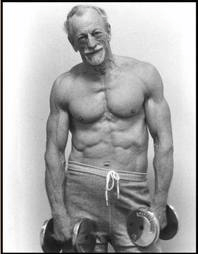
John Turner at age 67

This well known photo of John Turner at age 67, was taken in 1985, by Etta Clark.

I first saw this photo when I was twenty-one, working as a fitness appraiser and personal trainer.  A co-worker plastered it onto our client motivation board. I had no idea a person could age this well.  The impact of this photo has left a lasting impression on me.

Today, this photo adorns a spot on the wall tucked behind the door where I practice my chin-ups.  I take a peek at him from time to time as a reminder – this photo still takes my breath away.

There is another photo of him at age 79, but I was unable to attach it here.  He doesn’t look much different!

Photo from Etta Clark’s book: Growing Old Is Not For Sissies

Use Your Body

Cover of

You Are Your Own Gym by Mark Lauren, is a great reference book.

No need for me to reinvent the wheel.  He has said it all: Why Bodyweight Exercises, Why Strength Training (or Why Cardio Is a Waste of Your Time), Back to Basics Nutrition, Myths, Motivation and Intensity.  These are very short, straight to the point essays so you won’t spend hours reviewing the information.  The rest of the book is filled with bodyweight exercise descriptions including photographs.

Mark Lauren is a certified Military Training Specialist among other qualifications. He knows first hand the necessity for soldiers to be in optimal shape for physically demanding missions.  From solid research and experience he has successfully designed short workouts that support his cause.  His book makes these strategies accessible for all of us.

If you find the books’ practical content a little over your head, you can follow my 4 Minute Mornings’ progressions which will establish a great foundation for strength and flexibility.  My hope is that you will graduate from these progressions feeling confident to tackle any workout program.  Remember, just about anyone can do these exercises; there’s really nothing to it.  Consistency is the real challenge.  If you keep your exercise sessions short you are more likely to practice regularly.

Read You Are Your Own Gym.  Arm yourself with the information and put it into practice.

visit www.marklauren.com

The following are my two favourite bits of research perfectly condensed and described by Mark Lauren.

Izumi Tabata

by MLauren » Wed Jul 14, 2010 7:02 pm

Izumi Tabata and his partners at the National Institute of Fitness and Sports in Tokyo, Japan, compared the effects of moderate-intensity endurance and High-Intensity Interval Training on maximal aerobic capacity—the best indicator of cardiorespiratory endurance.
They conducted a six week study with two groups of randomly picked males.
Group 1 did one hour of steady state training five days a week. Group 2 did only 4
minutes of Interval Training five days a week.
At the end of the six weeks, Group 1 had an increase in maximal aerobic capacity of 10% and Group 2 had an increase of 14%. Not only did the interval group have a 40% greater gain in aerobic capacity, they had an increase in strength of 28% percent, as opposed to the Steady state group which had no gains in strength. And all this with just four minutes of Interval Training a day.  Similar studies have confirmed that Interval Training produces higher gains in aerobic fitness, greater decreases in body fat, and gains in strength as opposed to the muscle wasting that occurs with much longer sessions of steady state training.
And Cardio vs. High Intensity Interval Training by Mark Lauren

Dr. Angelo Tremblay

by ‪MLauren » Wed Jul 14, 2010 7:02 pm

Dr. Angelo Tremblay and his colleagues at the Physical Activities Sciences Laboratory, in Quebec, Canada, tested the popular belief that low-intensity, long-duration exercise is the most effective program for losing fat.

They compared the impact of moderate-intensity aerobic exercise and High-Intensity Interval Training on fat loss. Skinfold measurements revealed that the Interval Training group lost more body fat. Moreover, when they took into account the fact that the Interval Training burned less calories during the workouts, the fat loss was 9 times more efficient in that program than in the aerobics program.

In short, the Interval Training group got 9 times more fat-loss benefit for every calorie burned exercising. How can that be? Because, after taking muscle biopsies, measuring muscle enzyme activity, and lipid utilization in the post exercise state, they found that High-Intensity intermittent exercise caused more calories and fat to be burned following the workout. In addition, they found that appetite is suppressed more after intense intervals.

Which Workout Works?

The Tulip Stairs and lantern at the Queen's Ho...

Which Workout Works?

Rodan sent in this great article from last weekends’ The New York Times Magazine.  It is worth reading.

http://www.nytimes.com/2011/04/17/magazine/mag-17exercise-t.html?pagewanted=1&_r=2&ref=general&src=me

The article asks a range of exercise and sport physiologists to choose THE single best exercise.

Interestingly and really, not surprisingly the physiologists have very different views.

The short version is that all exercise has merit.  However, a strong argument is made for the overall effectiveness of interval training.  Short-Duration, High-Intensity Interval Training (HIT) is great for the time challenged.

The article goes on to say, that yes, “to be effective, HIT must hurt”.  I don’t want this to scare anyone off.  Everyone has a starting point.  Marching on the spot might ‘hurt’ for the absolute sedentary; ‘hurt’ is subjective.  What do they mean by hurt anyway? What I think they mean by ‘hurt’ is discomfort.  It means working hard and passing through the comfort zone to the point where you want to stop, but forcing yourself to finish the repetitions until the interval is over.  This is NOT to be confused with pushing through pain and losing technique just to score high repetitions.  There is a distinct difference between the discomfort caused by muscle fatigue and the pain caused from injury.

When we are consistent with exercise, our body naturally adapts and our ability to take on more increases.

It seems that what hurts the most is digging up the discipline to be consistent with exercising everyday.

Once you make the decision to try something different, I have got a little experiment for you: the stairs.  We all have to climb them and, like at the end of the article, one physiologist sings the praises of “running up steps”.

Find a staircase with approximately twelve steps.  But any number will do.

Make sure the staircase is straight and sturdy (no spirals), has a handrail and is not too steep.  Remember to go at a safe and comfortable pace. You may only climb the stairs once today, twice tomorrow and so on.  Listen to your body.

First, think about your body mechanics as you are climbing the steps.  Remember your feet and the arches.  Now go up the steps at a slow to moderate pace.  Trot back down.  Now go up the steps a little faster.  Trot back down.  Do this four more times.  Regardless of speed, the heart rate and body temperature will rise and breathing will quicken.

When finished, walk around until the heart rate and breathing slows down to normal.  Try it once a day for a week.

Leave me a comment.  I love hearing about your progress.


In Favor of the 4 Minute Morning

Waterfalls at Midnight

Today was the perfect argument in favor of the 4 Minute Morning.

My daughter had a fever in the night, which meant both of us were up every two hours and I was exhausted when morning came.  Her fever was down but she stayed home from school.  My schedule for the day had now radically changed.  After my son and I had our breakfast and he left for school I quickly did my 4 Minute Morning and a few stretches. Exactly what I needed to shake off that ‘all-nighter’ feeling.

I thought that I might be able to get my ‘planned’ workout in for the day even with my daughter at home, but it didn’t happen.  Tonight I will do my usual stretches (all of ten minutes) and get to bed early.

She just might wake up again in the night and I had better be ready.

Update:  She woke up twice in the night.


Change

Global Warming & Climate Change

Change does not always happen right away.  For me it took a couple of weeks just contemplating these new Short- Duration High Intensity Interval Workouts, to then implementing a few concepts into my gym workouts.

It had been drilled into me that to be effective a traditional workout could only be done a certain way.  This new approach challenged everything I had studied and what had worked for me in the past.  Or rather, what I believed had worked.

I then started substituting a home workout for a gym workout, until all my workouts were done at home.  The elapsed time for this transition took about eight weeks.  It is amazing to me the amount of time I have saved.  And the results I have gained.

Note: Short-duration High Intensity Interval Training (HIIT) and Tabatas are completely different from 4 Minute Mornings.  


The Rider

Cover of "The Rider"

My friend Ken sent this quote to me today.


“Velvet pillows, safari parks, sunglasses: people have become woolly mice.

They still have bodies that can walk for five days and four nights through a desert of snow, without food, but they accept praise for having taken a one-hour bicycle ride.

‘Good for you.’

Instead of expressing their gratitude for the rain by getting wet, people walk around with umbrellas.

Nature is an old lady with few suitors these days, and those who wish to make use of her charms she rewards passionately.”

from Tim Krabbe’s, The Rider