You As A Machine

One Lovely Blog Award

Miro from Warrior Poet Wisdom and The Curvy Spine have honoured me yet again from the wonderful world of WordPress with a nomination for the ‘One Lovely Blog Award’. It is such a lovely feeling to receive an award, but in particular from fellow bloggers.

Miro’s poetry resonates with me. From his work I can sense the passion and need for him to record the constant flow of words from within. He shares much needed lessons and reminders about values and living a full life.

The Curvy Spine is a lovely blog that shares her experience living with scoliosis. Her writing is open and honest and just lovely.

The One Lovely Blog Award goes to blogs that leave you with a good feeling, and that includes those that make me laugh, produce poetic and visually beautiful art. It’s my lovely honor to pass this award on to some other lovely bloggers. And since there are no rules or limits specified, this is a lovely opportunity to thank several of my lovely new friends here:

designrevolver

Nalaik Panda

Art Of The Stem

Richard Ess Photography

Justin Rabinowitz

kyiv2khabarovsk

Unga Bunga Girl

Skeleton Fingers

Italia La Dolce Vita

henriettekjeldal

Kana Tyler

ENJOY !

Candle Lighter Award

I have been honoured with another nomination from the WordPress World of Awards, this time for the Candle Lighter Award. I’d like to thank Miro from Warrior Poet Wisdom for this nomination. His poetry is beautiful, profound, inspiring and motivating.

This award belongs to those who believe,

Who always Survive the day

And those who never stop Dreaming,

For those who cannot quit,

For those who keep trying

And if you’re in this category,

You are Entitiled to this Award.

I’d like to nominate the following blogs for their positivity and dedication to excellence.

http://stayleanandbuilt.wordpress.com/

http://imyourfanclub.wordpress.com/

http://theawkwardduckling.wordpress.com/

http://fromscott.wordpress.com/

http://devezencuando591.wordpress.com/

http://10000waysthatwontwork.wordpress.com/

http://blondetakesnewyork.wordpress.com/

http://justasmidgen.com/

http://thecurvyspine.wordpress.com/

http://blackwomenlivingwell.wordpress.com/

http://ljayhealth.wordpress.com/

http://myfitstation.com/

Thanks again to Miro Warrior Poet Wisdom for the nomination.

“Light the Candle and Shine On.”

“Let’s set the blogging world ablaze with Candles for all the positive oriented blogs. The world needs joy and lots of it.”

~Kate, creator of the Candle Lighter Award

Roasted Winter Squash With A Twist

This side dish has a twist…

a twist of Lime Juice.

Where I live it’s cold outside. Most days are still above zero, but I’m more of a summer person and don’t do very well eating cold vegetables in winter time. As a result, I have been making a lot of roasted squash and root vegetables this fall and winter. This is one of my new favourite dishes. I first tasted it at Whole Foods Market‘s hot food bar. It’s not everyday that all ingredients will be on my acceptable list. I think I have left out one or two spices from the original, the following is my version. It tastes equally good hot or cold. And really good the next day for sure!

Ingredients:

  • 1 Organic Butternut Squash
  • 1 Organic Acorn Squash
  • Extra Virgin Olive Oil
  • Himalayan Salt
  • 1/4 – 1/2 Cup Chopped Fresh Italian Parsley
  • Fresh Lime Juice Squeezed from half or from all of one lime, (depending on preference).

Preparation: 

  • Wash Squashes.
  • Cut stem and bottom knot from squash, discard.
  • Cut Squash length-wise into halves.
  • Remove seeds and strings, discard.
  • Placing cut side down, cut squashes into inch thick slices and cut away tough outer skins – as shown below.

Place Cut Squash pieces in a mixing bowl. Splash in:

  • 1TBSP. of Extra Virgin Olive Oil and a light sprinkling of Himalayan Salt
  • Stir with a wooden spoon.

  • Arrange on a cookie sheet
  • Place into 350 degree preheated oven. Or go with whatever oven temperature works best for roasting. I use Parchment Paper. (below)

This next part is the time consuming part.

  • I set my oven timer for 30 minutes and let the oven do its work, checking the squash periodically.
  • Usually, at the 30 minute mark, I add another 20 minutes AND drop the heat to 300 degrees, or lower depending on how the squash looks.
  • Depending on how the squash are coming along I either take them out and turn each piece over or I let it continue baking longer.
  • Once each piece is turned I usually bake the squash for another 30 minutes 
  • AND lower the oven temperature to 275 degrees
  • Again, it all depends on how they look. I like them to develop a little caramelized look on the edges…not burnt nor dried out.

Here’s how my batch looked after approximately 90 minutes. In hind sight, I should have doubled my batch and had two cookie sheets going.

At the time of writing this, there is none left. We ate the last of the left overs tonight.

After they have cooled, slide them into a mixing bowl. I pick up my parchment paper and allow them to slide into the bowl.

  • Add 1/4  to 1/2 Cup of chopped Fresh Italian Parsley
  • Squeeze the juice from half of one Lime. (You can always add more later if it’s not enough).
  • Mix gently. Carefully to not squash your squash!

I find that the oil and Salt that the Squash bakes in is sufficient and there is no need to add extra.

Now, doesn’t this look like a measly amount for all the time spent in the kitchen? In total it equalled about 2 Cups! For this reason, I try to make a double batch. Luckily, my kids haven’t tried it yet and don’t know what they’re missing. Believe me, I’m not encouraging them to try this one, this one is ALL MINE. 🙂

Let me know if you give it a try. ENJOY!

Oh! And I used my iPhone and the Instagram App to take all these pictures, while I was preparing the rest of our dinner.

What If…? Part 3

US Navy 030830-N-9693M-006 U.S. Naval Academy ...

 In this post I will venture to explain some upper body mechanics…

Why too many downward dogs or push ups can give you a headache among other things.


Quick Review

In the previous two posts I touched upon:

  • How complex our body is
  • What a healthy muscle is
  • What fascia is
  • The relationship between muscle and fascia
  • How dysfunctional movement patterning can negatively affect our skeletal structure
  • A personal example of how repetitive overuse of imbalanced muscular patterning caused my legs to bow
  • Examples of similar types of bodywork: Rolfing/ Structural Integration, Kinesis Myofascial Integration (KMI), Wharton Performance Musculoskeletal Therapy (AIS), Active Release Therapy (ART)
  • Self-help methods: Feldenkrais, Alexander Technique, Pilates, Yoga, Body Rolling…
  • Listen to The Fuzz Speech by Gil Hedley or read the transcript
  • If you haven’t read the two previous posts view Part 1 here and Part 2 here before reading on.

When I was taking my Pilates Instructor Training Course, so many years ago, I was amazed at how much I didn’t know – boy that sounds arrogant! But it’s true – I was young and of course, thought I knew everything (much like my kids do now). My Pilates teacher, taught me to see with x-ray vision; which means, we were taught to analyze the way overused or underused muscles affected skeletal alignment – just by looking at someone. On the first day of this type of analysis, I remember feeling completely out of sorts: “You see what?” and “I have no idea what you’re talking about.” In time it all became so obvious, how was it that I couldn’t see all this before?

When the student is ready, the teacher will appear.

– Zen proverb

A quick side note: “The teacher” from my interpretation is not always a physical being. The teacher can be a spoken word or a situation, which contributes to an A-Ha! moment. The former scenario could have happened many times before, but it is at the precise moment when the student is really willing to see or is present, as if the planets have aligned like at the eleventh hour in a cinematic climax, the A-Ha! moment occurs. The teacher (or lesson) was always there, I believe all of our lessons are always circling around us, just waiting for that opportune moment. This idea conjures images of Glinda, the good witch from the Wizard of Oz, and those ruby slippers; Dorothy could have gone home at any time. The Lion, Tin-Man and Scarecrow all tell her that they should have thought of it for her…but Glinda reassures them that it was Dorothy, who had to think of it.

We are simultaneously teacher and student.

What does any of this have to do with doing too many push-ups or downward dogs? Bear with me…First:

1.We need to discuss neck and shoulder alignment.

2.What happens when we do too much of one exercise

3.Why being consistent with less, is more effective

1.We need to discuss neck and shoulder alignment.

The shoulder and neck regions are very complex, being made up of an intricate configuration of bones, cartilage, muscles, fascia, nerves, veins and arteries, which support our every move.

Just look at an example of how complex our internal wiring is (below):
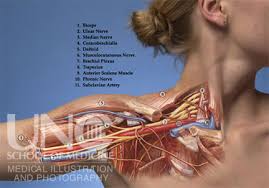
The shoulder blades (scapula, singular and scapulae, plural) need to be well balanced upon the back of our ribcage. There are many muscles, which participate in all our daily movements, which we don’t often think about unless we feel pain in our effort to function.

The rotaor cuff muscles, below (there are four: Supraspinatus, Infraspinatus, Teres Minor and Subscapularis),
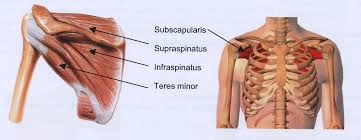
originate on our scapulae and insert onto our humerus (the upper arm bone). These muscles can work independently from one another and their main function, which is hugely important, is to stabilize the shoulder joint and provide movement of the arm bone, such as lifting and rotation.

But wait there’s more.
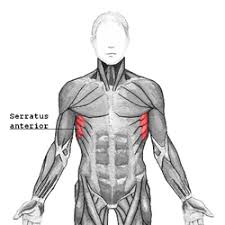
The Serratus Anterior, (above centre, seen here in red) also, happens to be one of my favourite muscles – I may quiz you on that later.

The Serratus Anterior (above and seen below left) combined with the Pectoralis Minor (below left)…

Pectoralis Minor originates on ribs 3, 4 and 5. They insert upward onto the Coracoid Process, which is a bony protuberance at the top of the scapula.

If the other muscle groups are not able to do their job or the Pectoralis Minor is over-compensating, the Pectoralis Minor can contribute in pulling the shoulder blade downward and forward.

…And on the back: Rhomboids, Levator Scapula, Teres Major (below left) and Trapezius (below right) all play a very important role in stabilizing the scapulae.
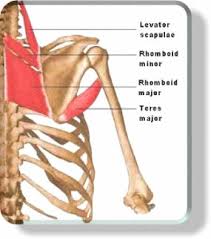
So all these muscles have to work in concert; like a symphony. Some muscles performing a fantastic crescendo when other sections are easing off into the whispers of pianissimo – this performance is happening ALL the time. This is what we mean when we talk about balance, which is why it is imperative to memorize movements in order to analyze them. As we become more proficient we focus less on how to do an exercise and more on how we feel doing the exercise, taking it to the next level of awareness; transformation comes as our awareness evolves. Exercising in this mind-full way is just not possible while watching TV, listening to music or having a conversation (hearing and having awareness of background noise and sound is very different from active listening). We actually must focus on the task at hand. To be mindful is to be focused.

Balance is something that is alive and is always fluctuating, it cannot be cast in bronze and held in place.

For example: if our Rhomboids are over-compensating for a weakness in our Serratus, the effect when attempting to do a push will then cause the shoulder blades to ‘wing’ (poke upward) causing more of an imbalance.

I have used the following quote before, it is so great that it stands repeating:

“Anatomy studies a projection of the static body, but function in the living requires more than static recognition.”

– Ida P. Rolf


2. What happens when we do too much of one exercise?

What happens when we do too much of one exercise, i.e., everyday, but in particular when we strain to squeeze out the last few repetitions beyond muscle failure.

The skeleton becomes compromised, the muscles and fascia can lose their functional slide and glide relationship – they can become stuck – nerves, arteries and veins can become impinged causing the next wave of who knows what…

…[Possibly,] “Thoracic Outlet Syndrome,” [which] can occur after trauma, such as with falls or accidents, which injure the neck/shoulder area, but more commonly the cause is a combination of muscle imbalances, and altered posture. These changes are common in those who spend long hours doing deskwork, or with certain sleeping positions, or improper workout routines.”

Dr John-David Kato DC, MSc, ACSM-RCEP, CSEP-CEP

Read more about Thoracic Outlet Syndrome here.
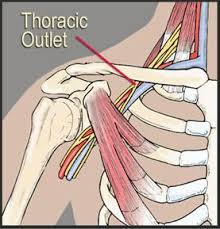
When this happens the end goal (a healthy, fit, functioning and balanced body) is sabotaged.

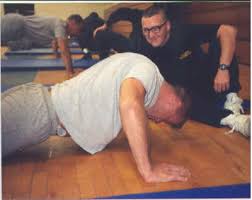
When we struggle with push-ups: the head drops forward, the neck muscles and shoulders are straining, this repeated practice is only reinforcing poor alignment. However, some will argue that they feel great. By pushing in the extreme they feel as though they ‘got a real workout’ and they can see the definition in their muscles, so in their mind ‘everything is coming along’.  It takes practice to fine tune pushing hard to our limit versus pushing hard beyond it.

The damage from pushing beyond our limit can have lasting effects, which don’t always surface until much later. Luckily, from what I’ve noticed, the body really does want to be healthy and happy. It has this amazing ability to regenerate. It seems to me that it is often the mind, which is more stubborn. To me, the body is like ‘man’s best friend’, it goes with you wherever, whenever, no questions asked. It will push for you beyond its limits, much like the dogs I see running the trails with their owners. Most dog breeds have no business running long distances, however, they carry-on for their owner, happy to do so, but sadly develop hip dysplasia (or something of the sort) requiring surgery. Most dogs are not meant for long runs, but are rather sprinters, who for themselves determine how much and for how long. Notice how those breeds naturally run in a game of tag only to stop and lay down to recover, then to bound up again to repeat the fun?  These breeds are the original Tabata athletes!

Where was I…

Also, there is a group of neck muscles called the Scalenes – Anterior, Medial and Posterior. (Below) You can see how the Scalenes are very deep within our neck.

The image (below) shows the nerves, known here as the Brachial Plexus (yellow), which pass through the Scalenes, including the subclavian artery, meaning it passes below the clavicle (under the collar bone), which pass again below the pectoralis minor muscle.
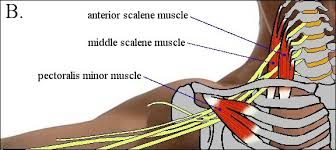
This image is intended to demonstrate how delicate our neck and shoulder structure is. And how easy it is to compress our nerves, arteries and veins when our skeleton is intentionally (through exercise) or accidentally (from trauma) pulled out of its optimal and balanced alignment.

Over-tightening of the Scalenes can pull on the Cervical Spine (neck vertebrae) pulling the neck bones forward which causes the head (chin) to tilt upward, Pectoralis Minor pulls the shoulder blades forward causing the shoulders to round, which compress the Brachial Plexus – the group of nerves exiting the neck area which can lead to tingling or numbness down the arms, among other possibilities. This is not good.

If your push up form resembles these two pictures (below), please practice modified push ups from your knees until you have developed a better balance within all the supporting groups of muscles that I have been talking about.

Regardless of my urging, if you insist on doing full push ups please analyze your form and before your body starts to go in this direction (see below), consider making a modification by dropping to your knees. From your knees if your form starts to fail, then stop – accept defeat with good form, that’s what we should be going for – or continue to work your way backwards to each modified version all the way back to the Wall Press. Once fatigued like this, it will surprise you how difficult even a wall push up becomes. It’s not how many you do, it’s how you do them.
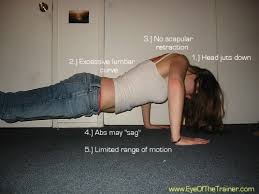
Under my 4 Minute Morning heading I have the progressions for learning the correct form for push ups, starting with Wall Press then gradually working towards the full push up. When we skip ahead, assuming we are already strong enough for push ups or other exercises, we miss out on the necessary progressions. By spending time with each progression we develop better awareness of the simplicity and complexity within each exercise.

Help Yourself:

The daily Micro Breaks Stretches that you have been practicing (ah-hem), will support your efforts, by encouraging mobility in the muscles that are getting tightened possibly just from existing, doing some or too many push ups. Also here is another link to view at Wharton Performance: an AIS (Active Isolated Stretch) for Pectoralis Major and Minor. If you click on the Wharton Performance link, you will be taken to their main page, click on the second video on this page, the title is: “Active Isolated Flexibility with Phil Wharton” and skip ahead to 7:05 in the video to view the chest stretch. I do this stretch daily and occasionally many times throughout the day when I find myself waiting on the kids to brush their teeth or something of the sort.

3.Why being consistent with less, is more effective.

When was this idea conceived anyway? The idea that we have to beat ourselves up for hours on end to prove our endurance and therefore our worth? Was it Chariot’s of Fire? When did it happen that we were convinced that we all had to train as if we were professional athletes? By the way, most professional athletes are riddled with overuse injuries…more on that another time.

Hopefully, you’ve already listened to Gil Hedley’s, The Fuzz Speech; Well this is my: Less Is More Effective – Speech. By being consistent with shorter workouts, done every day for the rest of our life, we won’t need to go beyond muscle failure – we just need to go TO muscle failure – I repeat, not beyond. With this in mind we can better focus on our technique and devote more useful time to our stretching routine which will support our structure.

This is another shout out for the short duration High Intensity Workouts. Only 4 – 12 minutes, maybe up to 20 minutes from time to time and sure, keep doing your long cardio workouts if you like them – from time to time – balance it out. But generally speaking, when we are consistent – read: daily – I have found that our body responds better with a short High Intensity Workout combined with regular periods of stretching throughout the day. All of it is important, but in particular, finding the balance with:
  • exercise intensity
  • type of exercise/ variety
  • stretching/Yoga
  • being focused/ mindful
  • ability to access the meditative state
  • eating/nutrition/hydration
  • 7 to 9 hours of sleep per night
  • rest and recovery from exercise
  • relationships/family
  • creativity
  • duty
  • chores
  • work
  • play…

Being the natural chatterbox that I am, I have got a lot more to share on this topic (the downward dog part, etc…) and will post it over the next week; A little at a time so you can digest the information before I add on.

“Write Your Own Prescription”

Pharmacy Rx symbol

I came across Lissa Rankin’s TEDx Women Talk video the other day. In it she references Brene Brown’s TED Talk video from 2010 and I wanted to connect these two video’s for you.

I have attempted to transcript a short excerpt from the end of Lissa Rankin’s talk for those who may have difficulty downloading the video. Hopefully, reading the transcript will be a motivator to find a way to view it in its entirety or to get a hold of her book. You can link to her website here and read her bio here.

…What’s the real reason I’m sick and suffering?…What’s out of balance? What’s the real diagnosis?

If taking care of your body isn’t the most important part of being healthy, what is?

It’s caring for the mind, caring for the heart, caring for the soul. Tapping into what I call your Inner Pilot Light. Your inner pilot light is that part of you, that essence, that authentic, deep, true part of you, that spiritual divine spark that always knows what’s right for you. You’re born with it, it goes with you when you die. It always knows the truth about you and your body.  It comes to you in whispers…It’s your intuition. It’s that beautiful part of you that is your biggest fan. The part that writes you love letters.

And that is the biggest healer you can tap into. Better than any medicine or any doctor.

…If any of you were lucky enough to see Brene Brown’s awesome TED Talk about the power of vulnerability…it talks about the science behind being true, being vulnerable, being transparent – It generates love and intimacy which increases oxytocin and endorphins and reduces harmful stress hormones like cortisol and adrenaline.

When we let our true self be seen, when we let our inner pilot light radiate, we heal from the inside out and its more powerful than anything medicine can give you from the outside.

So I challenge you to write the prescription for yourself. No doctor can do this for you. We can give you drugs, we can give you surgery and sometimes you need that – that’s the jump start – that’s the jump start of the self healing process, but to heal to the core, so that you don’t develop new symptoms, so that you don’t need another surgery, you’ve got to write your own prescription. So I ask you: What is it that you need? What does your body need to get healthy? What is it that you need to change? What needs to be tweaked in your life?

If you knew that stripping off all of your masks and letting us see that beautiful light within you was the solution to your health problems would you be willing to do it? I dare you. It just might make your body ripe for miracles.

– Lissa Rankin, M.D., OB/GYN

Lissa Rankin

Brene Brown

“Let me tell you very quickly about children. They are hardwired for struggle when they get here. When you hold those perfect little babies in your hand, our job is not to say: Look at them, look at her she’s perfect, my job is to keep her perfect – make sure she makes the tennis team by fifth grade and Yale by seventh grade. That’s not our job.

[As parents] our job is to look [at our children] and say…you are imperfect and you are wired for struggle, but you are worthy of love and belonging. That’s our job. Show me a generation of kids raised like that and we’ll end the problems that I think we see today.” – Brene Brown

“Be Active In Your Own Rescue”

Muhammad Ali taught me:

Cover of "The Greatest"

 Be active in your own rescue.

Harvard Business Review April 2011

by Peter Guber, Mandalay Entertainment

Failure has been my handmaiden on the road to success. I make movies and I own sports teams; those are two things you can’t do without a significant amount of failure. And public failure at that. Not every movie you make will succeed; every sports team eventually loses. If you’re not willing to confront failure, you’ll become risk-averse. And if you’re risk-averse, you’re doomed to fail and get stuck there. I was fortunate to learn this early in my career.

In the 1970s, as studio chief of Columbia Pictures, I began developing a film with Muhammad Ali, called The Greatest . I worked tirelessly with Ali and his production team to make it a success, but it failed to be the kind of box office hit that befitted one of the greatest athletes of all time. It was a high-profile failure—and I felt terrible. Everyone told me never to do another sports movie. I wanted to run and hide.

Sometime later, I acquired David Remnick’s book King of the World , another Ali story. I was worried that after the previous flop, he would refuse to support this new film. But when I approached him, Ali told me a story. He talked about a fight he was in where he was knocked down—“flat on my butt,” he said. “And I thought, OK. What’s next?”

He got up and won the fight.

When you don’t get up, he realized, there’s no way you can win. In fact, getting knocked down is part of being in the business. It’s inevitable. But once you know you can get up, no matter what, you become stronger and resilient.

Getting knocked down is part of being in this business. Muhammad Ali taught me two things with that story:

First, being afraid of failure—of getting knocked down—doesn’t get you anywhere. Running and hiding is not the answer.

You have to be active in your own rescue.

The second thing was the power of a purposeful story. The story you tell yourself when you think you’re down for the count—the story that gets you back on your feet—that’s what counts the most.

Since then, I’ve had great successes, but I’ve also been knocked down plenty. I’ve had hockey teams that couldn’t score, and I’ve invested in ventures that failed, costing me dearly. When our Bonfire of the Vanities was shown on airplanes, people still tried to walk out. But I never have the urge to run and hide. I remember what Ali told me, and I use the power of that story to help myself stay active in my own rescue.

Failure is an inevitable cul-de-sac on the road to success. Keep taking risks—and always get back up. Or you’ll never see how great your success can be.

Get The Fuzz Out

My friend Joanna, was at the Vancouver Yoga conference last weekend where she took a couple workshops with Leslie Kaminoff (author of Yoga Anatomy) and he showed Gil Hedley‘s, Ph.D., (founder of Integral Anatomy Productions, LLC, and Somanautics Workshops, Inc.) video “The Fuzz Speech” explaining why stretching is necessary for our body, perhaps an explanation you have never heard before. Outstanding!

Joanna told me about this video. I thought it might be a helpful addition to the fascia series I’ve been building on. Thank You, Joanna!

Warning: there are some images from a human cadaver which is helpful in understanding the topic. If you’re squeamish, close your eyes and just listen.

Here is a link to Gil Hedley’s YouTube Somanaut’s Channel.

Below, I have typed out Gil Hedley’s The Fuzz Speech, for those unable to view the video.

“Here’s the thing about the Fuzz: You can see it now, I’ll put it in [the video] over my voice.

The Fuzz yields to my fingertips. Sometimes I come across a stronger or thicker strand that doesn’t yield to my fingertips – that represents older fuzz sometimes, or maybe that represents the nerve. But each night when you go to sleep, the interfaces between your muscles grow ‘fuzz’, potentially – and in the morning when you wake up and stretch the fuzz melts; we melt the fuzz. That stiff feeling you have [in the morning] is the solidifying of your tissues, the sliding surfaces aren’t sliding anymore. There’s Fuzz growing in-between them.

You need to stretch.

Every cat in the world gets up in the morning and stretches its body and melts the fuzz in the same way that the fuzz melted when I passed my finger through it.

When you are moving it’s as if you are passing your finger through the fuzz, just like I did on the cadaver form here.

So you have to stretch and move and use your body; in order to melt that fuzz that is building up between the sliding surfaces of your musculature. The sliding surfaces, those shiny white surfaces, of the rectus femoris sliding against the vastus intermedialis. So, these sliding surfaces are all over your body and the fuzz is all over your body and as you move you melt the fuzz.

Now, what happens if you get an injury? Ah-ha! My Shoulder! [He grabs his shoulder] My shoulder is stiff now, I’m holding my shoulder. I go to bed, I wake up in the morning, I don’t stretch my shoulder – I’m afraid, it hurts. So, I’m wandering around like this, [demonstrates walking with his arm stuck to his side] – last nights fuzz doesn’t get melted. I go to bed; I sleep some more. Now I have two nights fuzz built up. Now, two nights fuzz is more fuzz than one nights’ fuzz. What if I have a weeks’ fuzz or a months’ fuzz? Now those fuzz fibres start lining up and intertwining and intertwangling and all of a sudden you have thicker fibres forming. You start to have an inhibition of the potential for movement there, It’s no longer simply a matter of going ooh-ahh stretch. Now you need some work. Now you might need to do a more systematic exploration of that place to restore the original movement that you lost; usually this is the case – we have a temporary injury then we restore movement but sometimes we call this ageing. The build up of fuzz amongst the sliding surfaces of our bodies so that our motions become limited, that limit cycles become introduced into our normal full range of motion and we start to walk around like this [he mimics frozen robotic movement]. We’re all fuzzed over, our bodies are literally solidifying. We’re reducing our range of motion in the individual areas of our body and over our entire body in general.

So, I believe that one of the great benefits of body work – whether it be massage or structural therapies or physical therapy or any kind of hands on therapy – These types of therapies introduce movement manually to tissues that have become fuzzed over through lack of movement, whether the lack of movement is because of an injury and a person is protecting that injury or because of personality expression. There was many years I just walked around like this: I was very still and monk like. So, then I became more dynamic in my personality when I realised what I was doing to myself and the kind of life that I wanted. So, you can grow fuzz by choice or by accident or whatever and yet here, now that you have heard the fuzz speech, you know that you can take responsibility for melting the fuzz and if there is too much fuzz in your body and it’s frozen up, you might want to seek help in order to introduce movement so that the new cycle is a little more movement and a little more movement and a little more movement instead of a little less movement and a little less movement and a little less movement.

Fuzz represents time. The easier it is for me to pass my finger through the fuzz, the less amount of time it’s been there. If I’ve got to whip out my scalpel, to dig my way through one otherwise sliding surface and another, you know that that’s been building up for a long time. So you can actually see time in fuzz.

That’s The Fuzz Speech.”

What Is a “Wheat Belly”?

Wheat (Triticum aestivum) near Auvers-sur-Oise...

By chance I caught this audio segment from CBC Radio‘s The Current.  Dr. William Davis, a cardiologist from Wisconsin postulates that the wheat grain used in agriculture today is very different from the wheat grain grown from fifty years ago.  As a result of this difference, he believes (aside from the increase in sedentary lifestyles) that the consumption of this grain is actually addictive which not only leads to overeating but also to an increase in the “accumulation of deep visceral fat – that is fat that accumulates around the organs but is shown on the surface as a large belly…It is this visceral fat that is different – it is unique, metabolically different from the other fat, say, found on your back side or arm or leg – it is metabolically active, it produces inflammatory proteins, it causes diabetes, hypertension etc.”

He calls this large belly a Wheat Belly, which is also the title of his book.  You might imagine the controversy his theory is generating among grain farmers and others.  Of course, I find this most fascinating especially if you consider my latest post titled, Full But Empty?

He briefly talks about the fact that in an effort to be healthy we are encouraged to eat more whole grains or complex carbohydrates most often in the form of whole wheat…’because complex carbohydrates sounds healthier versus simple sugars,’ but in fact they (the whole wheat grain) may very well be the source of the problem.  He comments on how people or his patients who complain that since they’ve been eating ‘apparently healthier’ or exercising more they have strangely put on more weight and can’t seem to shake it.

Something we need to address is: what is a complex carbohydrate in the first place?  Do you know?  The first item that comes to mind for most people is GRAINS.  But in fact, complex carbohydrates abound.  Here is a list from Livestrong.com of some, not all complex carbohydrates:

GRAINS millet, oats, wheat germ, barley, wild rice, brown rice, buckwheat, oat bran, cornmeal and amaranth.

FRUIT apricots, oranges, plums, pears, grapefruits and prunes.

VEGETABLES Broccoli, cauliflower, spinach, turnip greens, eggplant, potatoes, yams, corn, carrots, onions, all types of lettuce, celery, cucumbers, cabbage, artichokes and aspragus

Soy milk made from soy beans is a complex carb and dairy products like low-fat yogurt and skim milk are also complex carbs.”

As you can see, complex carbohydrates are in abundance, we are not at a loss if we should eliminate wheat as an experiment.  In fact if you do, you may find that you end up eating more vegetables which is a better choice regardless.

Here is the link for the audio segment from CBC Radio’s, The Current featuring Dr. William Davis. It is 24 minutes long.  When you open the link, just below the title/ opening paragraph you will see a black bar which reads- Listen: (Pop-up). Turn up your volume.

Maybe whole grain wheat could be utilized for other things such as cleaning products? It must be useful for something other than food. I would LOVE to hear any comments or stories that are relevant to to this topic…please share your ideas below.

Related Articles:

Three Hidden Ways Wheat Makes You Fat, by Mark Hyman, MD

To Do or Not To Do?

Just Do It Anyway

Image by MikeVC via Flickr

I read this great bumper sticker a few months ago: “Kids who hunt, trap and fish do not mug little old ladies”.  It got me thinking…

The Industrial Revolution brought with it an incredible opportunity for creative thinkers, builders and doers.  Yet, the same seed spawned a cloud of laziness for the masses.

Sliced, pre-packaged bread – no need to make your own anymore…who’s got time anyway? We have gone and replaced the time we’ve gained from these inventions with more things to do.  Because in truth, we are not lazy we are doers – each one of us.  We have gained more time to do more, but at what cost?

My point is that for a large part we have lost the art for having to take care of ourselves.  Not having to explore, create or examine because the fundamentals have been taken care of for us.  This wheel of convenience has run amok.

Humans need to ‘do’.  We are no different from the very busy animal kingdom.  We see the birds preparing their nests for spring: tending, feeding and guarding their nestlings.  This is their natural cycle, which is not so different from ours.  But ours has gotten muddled up.  Historically, our natural drive was to find shelter, be clothed, and eat three meals per day, dance and sing.  Presently, we still have this natural survival energy.  We need to burn it off somehow.  If we do not find a constructive way to utilize this energy we are going to sit around and overeat.  Much like the housebound dog that doesn’t get exercised; he gets himself into mischief to satisfy his natural drive, often in the way of eating a lone leather shoe or digging up the garden. Or, like the “kids who mug little old ladies”!

To think that those of us in Western society who are lucky enough to live in an age where education and personal development is attainable and affordable:  from life coaching, music lessons or personal fitness training to name a few…isn’t that fantastic?

However, it is what we do with this gift of learning that is worth questioning.  Has it become an affordable disposable luxury much in the same way that food has become?  (Read FUEL http://youasamachine.com/fuel-2/ to know what I’m talking about.)

Let me pick on personal training since it is my background.  Does personal training work? It depends. It always depends on a variety of factors. It depends on whether you hire a trainer as an educator or as your motivator.

I know way too many people going to personal trainers and not making progress.  Sure, maybe at the beginning when doing anything new will have an effect.  But as time goes on the people I have talked with admit to not doing any workouts except for when they have a scheduled appointment.  And even fitting in those appointments becomes challenging.

I think personal training would be more effective overall if sessions were viewed more as lessons, like swimming, martial arts or piano lessons for example. A lesson being something whereby you acquire further understanding of a subject.  You learn, practice, refine, learn more, practice more, refine more etc.

For the most part personal training has become a service of sorts, a session in which a client is often mindlessly put through their paces.  They leave feeling wiped out and think they got their money’s worth.  But has the client learned anything in the process?  Money can buy an hour with the best trainer on the planet but I don’t believe that it can buy health or a lean well-conditioned body. But if it does, it is only a temporary transformation. Yes, you’re better off having done a mindless session than none at all. But this reinforces dependence.

Your body doesn’t know how much money you have or don’t have.  You can deceive the mind but not the body.

If a client is seeing a trainer once to three times per week for a year and hasn’t made a significant change, which is to blame, the trainer or the client?  I would think that after one year of private instruction a client would be very well versed and on the road to becoming self-sufficient and accountable.  But that rarely happens.  Why?

In order to make progress in any subject we need to understand the fundamentals.  Before we can read we need to learn our A-B-C’s. In terms of our physical health and fitness we need to have a grasp of basic anatomy.  Does this mean that in order to brush our teeth effectively we should first be schooled in dentistry?  Not quite.  But our brains are able and hungry for knowledge and up for the challenge.

We all should be well versed in our anatomy and physiology, but we aren’t.  We let the experts take care of us!  We let doctors prescribe pharmaceuticals.  We let our governments come up with ‘programs’ to raise awareness to better our health.  It’s all fluff.  We need to take control of us.  En masse, we need to give our heads the proverbial shake.  Just like handing over our hard earned life savings to the expert to invest for us and not having done any research into where or what it is being invested.

Each and every one of us needs to become accountable.  We need to learn about how our body works so we can take care of it – and stay out of mischief.

Be accountable.  Become your own expert.

“Live as if you were to die tomorrow.  Learn as if you were to live forever.”

– Gandhi (1869-1948)

Sleep Longer

Stage N3 sleep; EEG highlighted by red box. Th...

Here is another sleep article I stumbled across today, from the mobile BBC News site.

“We should look at sleep as an active process.

Getting enough sleep is a positive thing which will help you perform in all aspects of life.

It may be that extra sleep leads to more effective training routines and helps us learn patterns better.

Practice makes perfect – and that happens more quickly if you get enough sleep.”                        -Derk-Jan Dijk

 BBC 1 July 2011 Last updated at 02:36 ET

Sleeping longer ‘helps athletes reach peak performance’

The value of sleep has been reinforced by
yet another scientific study.
Sleeping man
The true value of sleep is often overlooked, researchers say.

Research published in the journal Sleep suggests that sleeping longer can markedly improve physical performance.

When Stanford University’s male basketball team was asked to sleep for 10 hours a night for around six weeks, their shooting accuracy improved by 9%.

The study at the US university found that getting enough sleep and rest was as important as training and diet for elite athletes.

Cheri Mah, researcher at the Stanford Sleep Disorders Clinic and Research Laboratory, who worked with the basketball players, said that sleep was often overlooked.

“Intuitively many players and coaches know that rest and sleep are important, but it is often the first to be sacrificed,” she said.

The researchers asked the players to maintain their normal night-time schedule (sleeping for six to nine hours) for two-to-four weeks and then aim to sleep 10 hours each night for the next five-to-seven weeks.

During the study period, players stopped drinking coffee and alcohol. They were also asked to take daytime naps when travel prevented them from getting 10 hours of night-time sleep.

The study found that the players ran faster timed sprints (16.2 seconds at the start of the study compared with 15.5 seconds at the end), their shooting accuracy improved by 9% and their fatigue levels decreased.

The athletes also reported improved performance during competitive basketball games.

The findings suggest that it is important for sleep to be prioritised over a long period of time, not just the night before match-day, Mah says.

Sleep debt

She called optimal sleep an “unrecognised, but likely critical factor in reaching peak performance”.

She said the findings may be applicable to recreational athletes as well as those performing at school or at a higher level.

Before the study began, Mah and colleagues also discovered that many of the athletes felt sleepy during the day.

This indicated that they were carrying sleep debt accumulated from chronic sleep loss, she said.

“The athletes were unaware that it could be negatively impacting their performance.

“But as the season wore on and they reduced their sleep debt, many athletes testified that a focus on sleep was beneficial to their training and performance.”

Derk-Jan Dijk, professor of sleep and physiology at the University of Surrey, said we should look at sleep in the same way as exercise.

“We should look at sleep as an active process. Getting enough sleep is a positive thing which will help you perform in all aspects of life.

“It may be that extra sleep leads to more effective training routines and helps us learn patterns better. Practice makes perfect – and that happens more quickly if you get enough sleep.”

http://www.bbc.co.uk/news/health-13974130

“In Addition, sleep improves our ability to make novel connections among seemingly unrelated ideas. In other words, it sparks our creativity.”

-From Dr. Dana Colson’s book, Your Mouth: The Gateway to a Healthier You